5 Painting Mistakes That’ll Show | #PaintingTips #TalkToYourAgent #SiliconValleyAgent #YajneshRai

Facebooktwitterpinterestlinkedin

5 Painting Mistakes That’ll Show | Realtor Magazine

Painting can be one of the most cost-effective ways to spruce up a listing. But homeowners can also make a lot of mistakes with this common DIY job. Realtor.com® recently spoke with staging and color experts to find out some of the most obvious mistakes that they see most often.

1. Choosing the wrong finish.

Homeowners need to select a paint finish that correlates with the room’s purpose. “Many homeowners are nervous about using shiny semigloss, but it’s more durable than flat or matte and more moisture-resistant, which makes it perfect for bathrooms and the kitchen,” Kristen Chuber, marketing director at Paintzen, told realtor.com®. However, flat and matte finishes may make better choices for high-traffic areas like hallways or kids’ rooms, since they usually allow for easier touch-ups.

2. Not paying attention to the room’s undertones.

Pay close attention to the other elements of the room that can influence how the color looks on the walls. “Your color will look off if you pair a pink undertone with a yellow one, so look at the counters, the stone fireplace, and cabinets when choosing paint,” Karen Gray-Plaisted, a home staging expert with Design Solutions KGP, told realtor.com®. The flooring can influence the color perception too. For example, a warm mahogany hardwood might look strange when paired with a cool gray paint, Gray-Plaisted says. Also, be sure to “test your color swatches in different lighting, or you’ll end up with a shade that’s all wrong,” Chuber notes.

3. Selecting the wrong color of white.

White paint comes in many shades. “Some whites are cool, others warm, still more are neutral, so the one you pick will depend on the room’s finishes and undertones,” Gray-Plaisted says. Liat Tzoubari, CEO of home decor boutique Sevensmith, told realtor.com® she sees homeowners overuse white paint in a home. “Instead, choose a white with a slight pink or yellow tint, such as cream,” she suggests.

4. Forgetting about what’s overhead.

Ignoring the ceiling when repainting can make the room appear dull and dirty, says Chuber. “Whether you pick white or a bright color, painting it properly will give you those sharp edges along the top and can make wall color pop,” Chuber says.

5. Adding an accent wall in an odd place.

Adding a pop of color to an accent wall is a popular move, but homeowners should make sure the effect isn’t jarring. “Accent walls are supposed to draw attention to a beautiful area, like the dining room—but not the bathroom or toilet area,” Kaitlin Willhoit, a real estate pro with The Boutique Real Estate Group, told realtor.com®. Also, the paint chosen for the accent wall needs to still work with the overall color scheme of the room or the house, says Bee Heinemann, interior designer with Vant Wall Panels. Too bright or too bold a color may be a turnoff to buyers.

Facebooktwitterpinterestlinkedin

Survey: Buyers Leery of Online Mortgage Info | #OnlineMortgageInfo #TalkToYourAgent #SiliconValleyAgent #YajneshRai

Facebooktwitterpinterestlinkedin

Survey: Buyers Leery of Online Mortgage Info | Realtor Magazine

Consumers trust real estate professionals and lenders more than online sources or family and friends when it comes to obtaining information about mortgages, according to a new Fannie Mae survey based on 1,000 responses. Recent home buyers surveyed, including younger age groups, say they consulted multiple sources of information about the mortgage process but found lenders and real estate agents to be more credible than mobile apps, websites, and social media.

Though survey respondents say online sources are more convenient, they indicated a higher level of confidence in getting information through person-to-person interaction. However, home buyers do report using online sources to shop for a home much more often than to shop for a mortgage, according to the survey.

Facebooktwitterpinterestlinkedin

Large Yards May Soon Be The Thing of the Past | #ThinkingLargeYards #TalkToYourAgent #SiliconValleyAgent #YajneshRai

Facebooktwitterpinterestlinkedin

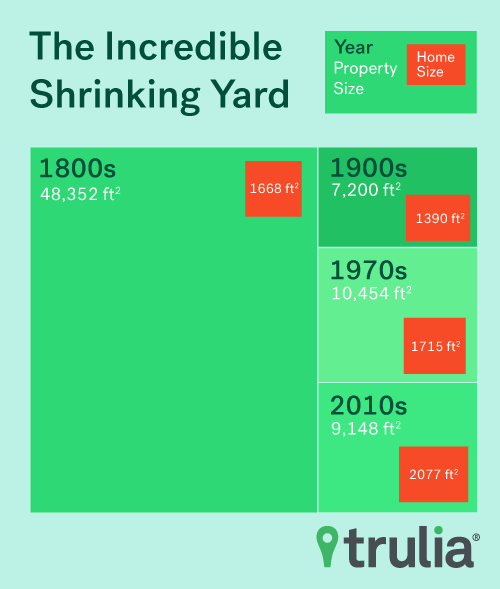
The Incredible Shrinking Yard! – Trulia’s Blog

The size of new homes has been growing for decades now, but it’s coming at the expense of yard space

America’s homes are getting bigger, but more space comes at a price: the backyard.

New single family homes are using land relative to home size at near-record levels, even after considering the number of stories homes have.

It’s a trend that has been taking shape for much of the past three decades as lot sizes continue to shrink and home square footage continues to grow. Homes built since 2015 occupy 25% of the land on which they sit, while homes built in 1975 occupy just 13.9%.

Many people like the idea of living in a single-family home and having a yard to call your own along with some space between themselves and their neighbors. In fact, surveys suggest that even city dwelling millennials aspire to a more traditional American dream of living in a large home in the suburbs and mowing their lawn on weekends. Nearly half, 46% of millennials, would prefer to move into a larger home compared with just 13% who would like to downsize.

Not only does where you live play a big role in how easy it will be find a place to live large inside and out, more importantly, when homes were built will have a big impact on how great of backyard barbeque you can actually hold.

Here are some key takeaways from our analysis:

  • Nationally, single family homes occupy 17.4% of the lots on which they sit, regardless of the year they were built.
  • Homes built since 2015 occupy 25% of the land on which they sit, while homes built in 1975 occupy just 13.9%. This is being driven by a combination of lots shrinking by 36.2% and home footprints growing by 15.2% size.
  • Meanwhile, some of the oldest homes in the country, built in the early 1800s, occupy less than 5.0% of the large lots they are built on. The last time lot usage was nearly as high as it is now was during the early 1900s.
  • Don’t mind the neighbors? Single family homes in places like Philadelphia, and San Francisco, which are both geographically small but dense, have the highest lot utilization at 57.7%, and 44.2%, respectively.
  • Want plenty of yard space? Head to New England. Three Connecticut metro areas, Worcester, Mass., Hartford, Conn., and Bridgeport, Conn. make up the places with the smallest amount of house occupying lot space, at less than 7.5%.
  • While most metro areas have seen lot usage grow since the mid-70s, with Oakland, Calif., and Miami seeing the largest upward swings, six metros have bucked the trend with San Francisco, Memphis, and Long Island, N.Y. moving toward less lot usage.

Lots Keep Shrinking and Homes Keep Growing


As America moved to an industrial economy from an agrarian one, the size of single family homes’ footprints generally fell to 1,420 square feet in the early 1900s from 1,740 square feet for homes built in the early 1800s. At the same time, the typical lot size on which they were being built decreased in size to 6,860 square feet, or 0.16 acres in the early 1900s from a median of roughly 56,000 square feet, or around 1.25 acres. This dramatic fall in lot sizes, paired up with a more modest decrease in the size of houses’ footprints resulted in a steady increase in lot usage from less than 4.0% to more than 21.5%.

After that though, the trend reversed for a while, with home and lot sizes increasing in tandem from the 30s through much of the 1970s – the age of suburbs – with the median lot size growing to 12,430 square feet


(0.3 acres) and the median home footprint growing to 1,824 square feet. Home and lot growth during much of this period were partially spurred by the post war economic boom, the relatively new ubiquity of automobile use which allowed people to live further from dense urban areas, and was all punctuated by the building out of the Interstate Highway System, which made far-flung places less far flung.

The rise of suburbs brought lot usage down to 14.5% for that decade. Since then, however, while the size of home footprints has continued to grow, lot sizes first stopped growing, then began shrinking again in early 1990s. For homes built since the start of 2015, the estimated footprint is 2,113 square feet (down from an all-time high of 2,125 in 2014) while the lot they are built on has shrunk to 8,940 square feet, or 0.2 acres, bringing lot usage up to a near-record high of 25%.

A Day in the Park vs. A Day in the Yard

Among places with the tightest lots, most have seen an unusually high proportion of their building occur during periods when tighter lot construction was the norm. In addition to San Francisco and Philadelphia, places like Chicago and Detroit all have among the highest proportion of their housing stock built between 1890 and 1929, which was the first time lot usage peaked. Other places near the top of the list, like Las Vegas and Phoenix, have had among the highest portion of their housing stock built after 1996.

There are still many places where newly constructed homes still have plenty of free space, despite the national trend. All four Connecticut metros in the analysis are among the top 10 places for plenty of lot space overall. Even just looking at homes built after 2014, Worcester, Mass., Hartford, Conn., Bridgeport, Conn., and New Haven, Conn., are all places where a home’s footprint take up less than 10% of the lots on which they sit. Still looking at only homes built since the start of 2015, New England metro areas in general seem to be leading the nation in minimizing lot usage, though this is not the case when considering all homes in these places, regardless of when they were built. Providence, R.I., Cambridge, Mass., Albany, N.Y. and Boston are also bucking the national trend with newly constructed homes occupying less than 10% of their respective lots, though these places all have slightly higher lot usage for their housing stock overall.

Facebooktwitterpinterestlinkedin

Remodeling Activity to Spike Through 2018 | #HomeOwnersRemodelling #TalkToYourAgent #SiliconValleyAgent #YajneshRai

Facebooktwitterpinterestlinkedin

Remodeling Activity to Spike Through 2018 | Realtor Magazine

As homeowners gain more equity, they are expected to continue heavily investing in home improvement projects and repairs through the third quarter of 2018, according to the latest Leading Indicator of Remodeling Activity report released by the Joint Center for Housing Studies of Harvard University. The LIRA index projects annual gains in home renovation and repair spending of 6.3 percent for the fourth quarter of 2017 and up to 7.7 percent by the third quarter of next year.

“Recent strengthening of the U.S. economy, tight for-sale housing inventories, and healthy home equity gains are all working to boost home improvement activity,” says Chris Herbert, managing director of the Joint Center for Housing Studies. “Over the coming year, owners are projected to spend in excess of $330 billion on home upgrades and replacements, as well as routine maintenance.”

Abbe Will, a research associate in the Remodeling Futures Program at JCHS, says that recent hurricanes and other natural disasters have the potential for strengthening remodeling activity even more over the next year than forecasted. Major reconstruction and repairs will get underway in affected regions and likely lead to elevated activity, Will says.

For homeowners looking to remodel for resale, the National Association of REALTORS® publishes a report looking at the costs of some of the top remodeling projects. Take a look at the 2017 Remodeling Impact Report.


Facebooktwitterpinterestlinkedin

Loan Factors to Consider When Buying Home | #LoanFactors #TalkToYourAgent #SiliconValleyAgent #YajneshRai

Facebooktwitterpinterestlinkedin

Factor in size and location.

  • State or County: Even your place of residence can affect your rate.
  • Local Mortgage Lenders: Shop around. Interest rates can vary from company to company even if they’re located in the same town.
  • Loan Size: The size of your home can also impact your interest rate. The bigger the loan, the higher your interest rate will be if you’re not putting more money down.
  • Down Payment Size: Your mortgage interest rate may also depend on how much you’re putting down and if your loan includes closing costs and private mortgage insurance (PMI). Putting down less than 20 percent can increase your risk factor and may require PMI, but your interest rate may be lower depending on the loan.

Not all loans are created equal.

Loan Length: Your loan terms play a bigger role in interest rate calculations than you think. Have you decided whether you want to pay off your loan in 15 or 30 years? You may pay more per month with a shorter term, but you’ll be paying less interest over the life of your loan. Short-term loans may also have a smaller interest rate.

Fixed or Adjustable: You’ll also have to consider whether a fixed- or adjustable-rate loan is right for you. Your interest rate can change over time if you choose an adjustable-rate loan. It may start off low or fixed, but can increase over time depending on market conditions. Fixed-rate loans, however, will have a higher interest rate attached to them.

Loan Type: Interest rates can also vary according to your loan type. Choosing a loan can be overwhelming, but a local lender should be able to provide you with the best options. Some of the more popular loans are conventional, FHA and VA loans. While FHA loans have less down payment restrictions and a smaller interest rate, your monthly payment can be more expensive due to the required PMI added on. VA loans can have smaller interest rates and don’t require PMI like FHA does. Conventional loans are widely accepted in the real estate industry as dependable, but your interest rate may be higher.

Facebooktwitterpinterestlinkedin

Don’t let these little-known mistakes damage your credit | #ProtectYourCredit #TalkToYourAgent #SiliconValleyAgent #YajneshRai

Facebooktwitterpinterestlinkedin

5 Sneaky Things That Can Ruin Your Credit Score

Don’t let these little-known mistakes damage your credit.

No matter if you’re renting in San Jose, CA, or Austin, TX—your credit score will matter. There’s no getting around the fact that landlords and apartment property managers can put a lot of weight on that one number when determining whether you can handle making your monthly rent.

But you may not know why your credit score is so dismal, especially when you’re trying to play it safe and maintain credit worthiness by paying your bills on time and in full. Aside from forgetting to pay bills, what can ruin your credit? If you’re on top of payments, why is your score still lacking?

If you’ve checked your credit score only to find yourself shocked and dismayed by the result, your score may be suffering from one of these sneaky things that can ruin it.

5 Credit Score Pitfalls to Avoid


  1. 1. Generating too many inquiries

    Shopping around before choosing an institution for a car loan can help you find the best rate—and that can translate into thousands of dollars in savings (if not more!) over your loan’s lifetime. But while you may be saving, it’s best to use moderation. Here’s why.

    When you receive a quote on interest rates, lenders pull a hard inquiry that shows up on your credit report. If you request these inquiries over a period longer than 14 days, each quote shows up individually. When you’re comparison shopping for a loan, gather your quotes in a short period (ideally within two weeks). That way, your credit will take less of a hit.

  2. 2. The little things can add up

    Unpaid bills from a variety of sources can cause your credit score to plummet if they’re unresolved. Think that library late fee or medical invoice from 15 years ago doesn’t matter anymore? It could, if the library system turns that account over to collections or marks it as “delinquent.”

    In most cases, this is an easy fix and just a matter of settling the outstanding payment. To check for these issues, pull a credit report—you can get one for free each year from the three credit-reporting agencies (Experian, TransUnion, and Equifax).

  3. 3. Incorrect information

    Let’s get real: You’ll probably want to pull your credit report for more than to see if you owe your librarian a few bucks. Errors occur and businesses make mistakes. If your credit report is harboring incorrect information about your financial records, this could drag down your credit score. If your report has an error, call the credit bureau that issued the report and file a claim. Correcting errors can be long and arduous, but it’s worth the effort.

  4. 4. Using your credit a little too much

    If you use your credit cards for everyday spending and pay off your balances—on time and in full each month—you may be wondering why your credit score is still suffering. Even if you’re paying it off responsibly, maxing out your credit card can harm your score more than you might think. What matters here is how much credit you have and how much credit you’re using. For example, if you have a $1,000 line of credit and you charge $999 each month, you’ll earn a black mark on your credit score even if you pay off every dime when the bill comes due. This balance of limit versus spending is known as a credit utilization ratio. Maintaining a high credit utilization ratio will hurt your score. If possible, try to keep balances low on your lines of credit.

  5. 5. Not using credit at all

    The silent way to ruin credit is by not using it at all. If you’re afraid of tripping up and getting into a financial mess, or if you’ve been scared off the idea of using credit by financial “gurus,” you may negatively impact your score. With no credit history, there’s nothing to show that you’re a responsible user of credit who can manage balances and payments. Inactive accounts may even default to closed over time, and that too can ding your score. It might not be fair, but the fact remains that those looking to rent an apartment need to develop and maintain strong credit scores. If you want to secure the best apartments out there, be wary of these credit score pitfalls that can hurt your score.


Facebooktwitterpinterestlinkedin

Choose Home Upgrades Wisely | Some Add Value Some Dont | #HomeUpgrades #TalkToYourAgent #SiliconValleyAgent #YajneshRai

Facebooktwitterpinterestlinkedin

Which Home Upgrades Will You Lose Money On? – Trulia’s Blog – Life at Home

Just because you upgrade doesn’t mean you’ll profit when it comes time to sell.

If you’re hoping to increase your home’s value (above and beyond the cost of an upgrade itself), you should know that the upgrades you value might not be valuable to potential buyers. In fact, you may never recoup the full cost of some home improvements, and the primary offenders might surprise you!

Five common upgrades with the worst return on investment

  1. Adding a pool
    Pools can be hit-or-miss when it comes to added value. If you’re selling Orlando, FL, real estate, or you live in a warm climate where people are inclined to use a pool year-round, you’re more likely to get a favorable response from buyers. Often, however, the return is not enough to pay for the pool itself. Don’t forget to budget a large chunk of change to operate and maintain the pool. Ultimately, your likelihood of recouping the money you spent on maintenance, in addition to the installation costs, is fairly low.
    Adding a pool to your home could be a major turnoff to some buyers. Buyers with small children may be concerned about safety risks, those looking for a low-maintenance yard won’t want to deal with the hassle and upkeep of cleaning a pool, and buyers who are on a tight budget may not have the extra cash to deal with the added expense.
  2. Highly custom designs
    Unless you plan to stay in your house for many years to come, think twice about renovations that are too personalized. Installing a kitchen backsplash? The specific type of tile might not matter to buyers — they could be just as happy with a simple ceramic tile as they would with an expensive Calacatta marble tile. Similarly, choosing a beveled countertop edge that’s complex and ornate, rather than a basic beveled edge, could off buyers whose tastes don’t align with yours.
    In fact, these custom features may wind up costing you come listing time, as many buyers will factor in the money they’ll need to spend to change the house to suit their own tastes. If you’re going to upgrade your kitchen just for the sake of selling, stick with neutral, builder-grade design decisions.
  3. Room conversions
    Buyers look to check certain boxes when they tour your home: For example, three bedrooms, two bathrooms, and a garage. Getting rid of these expected spaces (or altering them into something unusual) may harm your resale value. Bedrooms are coveted spaces that can bump your listing up into the next bracket. Buyers are looking for a specific number of bedrooms, and may not appreciate the work it took to take a wall down for a secondary master suite, or the soundproof foam to convert into  a recording studio.
  4. Incremental square footage gains
    Sizable square footage gains — like finishing your dingy basement so it becomes an additional livable floor — can be a boon in buyers’ minds. But tiny, insignificant changes may not give you much of a return on your investment. You may love your new sunroom, but it’s not likely to drastically increase your home’s overall value. Adding square footage in a way that doesn’t flow well with the floor plan can also backfire. Sure, a half bath on the first floor would be useful, but if buyers have to pass through the kitchen to get to it, the half bath loses some of its appeal.
  5. Over-improving

    When your upgrades feel overboard for your neighborhood, you alienate buyers on two fronts: buyers who are drawn to your neighborhood won’t be able to afford your home, and buyers who can afford a home of your caliber will prefer to be in a ritzier area. Keep the “base level” of your neighborhood in mind. Tour some open houses on your block to see how your neighbors’ kitchens look before you invest a small fortune in granite countertops and high-end fixtures. Being a little nicer than the other houses around you can be a selling point, but being vastly more luxurious is not.
    Pursue these home upgrades for your own enjoyment — but don’t trick yourself into believing you’ll more than recoup the cost of the improvement in the form of a much larger listing price when it comes time to sell. You can always opt for the projects that have the best potential to draw in a buyer instead!

Facebooktwitterpinterestlinkedin

Younger Buyers Lean Towards Condos | #GreatOption #TalkToYourAgent #SiliconValleyAgent #YajneshRai

Facebooktwitterpinterestlinkedin

Childless Buyers Buoy Condo Market | Realtor Magazine

Home shoppers without children are a growing segment in the housing market, and they tend to desire smaller houses than previous generations.

The fertility rate among women 15 to 44 years old is at its lowest level since the CDC began recording such rates 108 years ago. As more couples delay having kids or opt to have fewer children, their needs in the housing market are very different than previous generations who tended to have bigger families.

Fewer than eight in 10 childless buyers purchased a detached single-family home between July 2015 and June 2016, according to the National Association of REALTORS®. Condos and townhomes are becoming a popular option among those who do not have children.

“Buyers may value smaller/attached homes in the future,” The Mortgage Reports notes in a recent article. “Increased demand for these types of homes could amp up your resale value.”

In general, detached homes have been known to appreciate faster and hold their value longer than attached homes, according to Tamara Dorris, adjunct real estate professor at American River College in Sacramento, Calif. But that could change.

“We’re seeing more and more people not having children by choice or purchasing homes as singles,” Dorris says. “These people tend to live in urban areas and have homes with less maintenance—such as attached homes.”

Could the rise of childless couples lead to less demand for detached single-family homes?

“If others fit the mold of not having children, there could be a decline in buyers who might have an interest in your detached home,” Mark Lee Levine, professor at the Burns School of Real Estate and Construction Management at the University of Denver, told The Mortgage Reports. “But there is no right or wrong answer as to whether it’s better to buy attached or not attached. Buyers need to consider many issues that will impact the potential interest in their home and when they become sellers.”

Facebooktwitterpinterestlinkedin

7 Secrets for Adding a Finishing Touch to Your Staging | #ThinkingOfSelling #TalkToYourAgent #SiliconValleyAgent #YajneshRai

Facebooktwitterpinterestlinkedin

7 Secrets for Adding a Finishing Touch to Your Staging

When staging a home for an open house, you can transform a space from an unimpressive, run-of-the-mill property to one with a “wow” factor. But without a little extra attention to detail, even the most professionally staged homes can leave something to be desired. Don’t let staging efforts go to waste—advise your clients to put the finishing touches on their staged homes, and boost their chances of selling. Here is a list of seven often overlooked finishing touches that can make a home shine.

1. Switch the lights.

It may seem like a big project, but switching out ceiling light fixtures is actually quite simple. Replacing old or broken fixtures can add a polished look and make a home feel updated. Remember that during showings and open houses, all lights will be on, so buyers’ eyes will be drawn to them. Choose something timeless that will go with any décor. And don’t forget the switch plates – dingy or yellowed light switches can make a staged room feel incomplete.

2. Consider window treatments.

Your clients may hesitate to replace blinds or shades before they move, because they can’t take them when they go. But remind them that custom window treatments can add significant value to the sale price. The right treatments can add privacy, style, and even energy efficiency to the home. They’re also the perfect way to frame a professionally-staged room. During your showing, treatments should allow as much natural light into the home as possible. Natural light balances any overly yellow lightbulbs and provides a blank canvas for the buyers to see clearly.

3. Touch-up the paint.

A professionally staged home will have impeccable furnishings and accessories. But chipped baseboards or scuffed walls can undo that polished look in an instant. Advise your clients to go through the home with touch-up paint and get rid of the most obvious offenses. It’s a simple way to hide the home’s age, and keep potential buyers focused on the its best attributes.

4. Give the floors some attention.

Stagers may add area rugs, but their not to hide scratched hardwoods or stained carpeting. Recommend that your clients make the investment into buffing and deep cleaning the flooring, so the rest of the staging looks at home in the pristine environment.

5. Add a little life.

Staging companies may add artificial plants as décor, but the living variety are even more appealing. Fresh flowers and houseplants brighten dining rooms, entryways, and bedside tables. Go neutral white or use this as an opportunity to add a pop of color. Also, try bowls of fruit, hanging ferns, or a small window herb garden to avoid having to put fresh flowers out every week. Don’t forget to look outside and freshen up the flower bed with new blooms and/or add a few potted plants around the front door.

6. Remove personal items.

Another final touch to making sure the staging looks natural is to remove any overly personal distractions. Remove family photos and memorabilia. If your sellers want to leave the frames on the wall to hide nail holes, have them consider putting a nice landscape print or piece of scrapbook paper in that spot instead. This goes for art, too. Your potential buyers might not share your enthusiasm for turn of the century pop-art, so the best choice is to swap it out for something classic, or remove completely.

7. Don’t forget storage areas.

Stagers will give special attention to the main living areas, but storage spaces like garages, closets, and basements are also vital selling points that need attention. Potential buyers look for roomy areas where they’ll be able to fit all their stuff. If basements and garages are overcrowded, it might send the signal that the home isn’t big enough for the buyers’ needs. Sellers may benefit from renting a storage space to help declutter and make every inch of the home irresistible.

Facebooktwitterpinterestlinkedin

Self-made millionaire: Not buying a home is the single biggest millennial mistake | #BuyYourHome #TalkToYourAgent #SiliconValleyAgent #YajneshRai

Facebooktwitterpinterestlinkedin

Self-made millionaire: Buy a home

While opponents of homeownership claim it’s “the American nightmare,” self-made millionaire David Bach is doubling down on his faith in real estate.

He thinks that not prioritizing homeownership is “the single biggest mistake millennials are making.”

Buying a home is “an escalator to wealth,” he tells CNBC.


Young adults in particular aren’t hopping on this escalator, and it’s a costly mistake, Bach warns: “If millennials don’t buy a home, their chances of actually having any wealth in this country are little to none. The average homeowner to this day is 38 times wealthier than a renter.”

The self-made millionaire is quick to say that the smartest investments he’s ever made have been the three homes he’s purchased. He tells CNBC: “I first bought a home in San Francisco. It skyrocketed in price. I moved to New York and bought another home. It skyrocketed in price. My net worth has gone up millions and millions of dollars, simply because I’ve lived.”


Courtesy of David Bach

Self-made millionaire and bestselling author David Bach

Bach argues that you have to live somewhere for the rest of your life, so you might as well invest in a home that you could own permanently.

As he writes in “The Automatic Millionaire,” “As a renter, you can easily spend half a million dollars or more on rent over the years ($1,500 a month for 30 years comes to $540,000), and in the end wind up just where you started — owning nothing. Or you can buy a house and spend the same amount paying down a mortgage, and in the end wind up owning your own home free and clear!”

If you want to get in the game of homeownership, start by crunching the numbers, Bach says: “Actually do the math. Look and see what things costs, starting with the smallest options. This way, you’re really clear on your goals and you won’t just say to yourself, ‘I’ll never afford this.'”

A good rule of thumb is to make sure your total monthly housing payment doesn’t consume more than 30 percent of your take-home pay. He also recommends having a down payment of at least 10 percent, though more is always better. Finally, recognize that “oftentimes, buying your first home means you’re not buying your dream home,” Bach tells CNBC. “You’re just getting into the market.”

A lucrative market, that is. “The fact is, you aren’t really in the game of building wealth until you own some real estate,” Bach writes.


Facebooktwitterpinterestlinkedin