5 Financial To-Dos for First-Time Buyers | #PreapareToBuy #TalkToYourAgent #SiliconValleyAgent #YajneshRai

Facebooktwitterpinterestlinkedin

5 Financial To-Dos for First-Time Buyers | Realtor Magazine

First-time home shoppers come to you eager to buy, but there’s a lot they need to do before they start touring listings and submitting offers. Make sure you keep them on track so that the path to closing is smooth. Here are a few items you can remind them to do to make sure their finances are in order.

1. Determine total monthly housing budget. 

What can your clients really afford? The total should include estimated taxes and home insurance costs, too. After all, in some places, that can double your mortgage payment. Buyers should be encouraged to talk to an insurance agent to get an estimate of the costs in the areas in which they’re looking to buy. Mortgage financing giant Fannie Mae recommends home buyers spend no more than 28 percent of their income on housing. Buyers may start to struggle financially when housing costs take 30 percent or more of their income, financial experts warn.

2. Factor in the closing costs. 

Buyers shouldn’t be blindsided by the cost of a transaction. Be sure you explain everything from origination fees, title and settlement fees, taxes, and prepaid items (such as homeowners insurance or homeowners association fees). They’ll get more precise numbers from their lenders as they get through the paperwork, but a general estimate will help them ensure they’re shopping within their budget from the onset.

Read more: 4 Expenses Your Buyers Don’t Expect

3. Examine creditworthiness. 

Will your client even be able to qualify for a loan? Buyers should get a free annual credit report and look for any errors or unresolved issues. They should contact the credit reporting bureau immediately if they spot any errors. They also might want to determine their FICO credit score, which many lenders use to help determine an interest rate for financing. 

4. Prepare documents. 

Buyers will need to be ready to show a lot of documents when applying for a home loan. These include pay stubs, bank account statements, W-2s, tax returns for the past two years, statements from current loan and credit lines and names and addresses of landlords for the past two years. Gathering these together ahead of time will help make the process smoother and faster.

5. Get preapproved. 

This not only helps buyers get a better understanding of what they can truly afford, but it also puts them in a better position to submit an offer when they find a home they love. Also, financial planners say applying to multiple lenders in the same month may help boost a buyer’s chances of getting a loan approved at the best rate possible without dinging their credit score too much. 

Facebooktwitterpinterestlinkedin

The Home Designs Gaining, Losing Popularity | #PopularDesigns #TalkToYourAgent #SiliconValleyAgent #YajneshRai

Facebooktwitterpinterestlinkedin

The Home Designs Gaining, Losing Popularity | Realtor Magazine

Builders are slowly switching focus from the $500,000-plus luxury market to more moderate price points, particularly when it comes to single-family move-up homes. And the shift is influencing the types of materials and upgrades becoming popular in new homes, according to Home Innovation’s 2017 Builder Practices Survey. It turns out that high-end materials aren’t limited to construction of luxury real estate.

  • Crazy for quartz. Despite being one of the priciest products on Home Innovation’s list of building materials, quartz had its best year in 2016. Quartz surfaces in the bathroom appeared in 13 percent of new homes last year, up from 9 percent in 2015. In the kitchen, quartz countertops were even more popular, appearing in 15 percent of new homes last year compared to 9 percent in 2015.
  • Nickel gains ground. Nickel faucets are also gaining popularity in kitchens, outselling stainless steel, chrome, and bronze. In the bathroom, nickel is also being used more often, though it fell just shy of chrome in popularity. 
  • Hardwood, vinyl are tops for floors. High-end solid hardwood and luxury vinyl tile are popular for kitchen floors. But engineered hardwood and ceramic tile each rose by 3 percentage points in market share.
  • No more bubble baths? The jetted tub is continuing to lose favor, going from being installed in about 15 percent of new homes in 2015 to 11 percent in 2016.
  • Granite and marble are on the outs. The share of new homes with natural granite and marble showers and bathtubs dropped from 12 percent to 9 percent last year. High-end enameled cast iron and granite sinks also lost favor. Lower- to mid-range vitreous china and enameled steel sinks each increased in popularity. 
Facebooktwitterpinterestlinkedin

Understanding the Role of the Real Estate Agent |#ReasonsToHireAgent #TalkToYourAgent #SiliconValleyAgent #YajneshRai

Facebooktwitterpinterestlinkedin

Understanding the Role of the Real Estate Agent – Zillow Porchlight

The road to homeownership can be bumpy, and it’s often filled with unexpected turns and detours. That’s why it makes sense to have a real estate pro help guide the way.

The road to homeownership can be bumpy, and it’s often filled with unexpected turns and detours. That’s why it makes sense to have a real estate pro help guide the way.

While real estate websites and mobile apps can help you identify houses you may be interested in, an experienced agent does much more, including:

1. Guide. Before you tour your first home, your agent will take time to learn more about your wants, needs, preferences, budget and motivation. A good real estate agent will help you narrow your search and identify your priorities.

2. Educate. You should expect your agent to provide data on the local home market and comparable sales. The home-buying process can be complicated. A good agent will explain the steps involved – in a manner that makes them understandable – and provide counsel along the way.

3. Network. An agent who is familiar with your target neighborhoods will often know about homes that are for sale – even before they’re officially listed. Experienced agents tend to know other agents in the area and have good working relationships with them; this can lead to smooth transactions. Your agent may also be able to refer you to trusted professionals including lenders, home inspectors and contractors.

4. Advocate. When you work with a buyer’s agent, their fiduciary responsibility is to you. That means you have an expert who is looking out for your best financial interests, an expert who’s contractually bound to do everything in their power to protect you. If you find yourself in a situation where the same agent represents both the buyer and seller, things can get trickier, advises Scottsdale, Arizona-based real estate agent Dru Bloomfield.

“A lot of people think they’ll get a lower price by going straight to the listing agent, but that’s always not true,” she says. “If I was representing both the buyer and seller, I’d be hard-pressed to take a low-ball offer to the seller. But, as a buyer’s agent I’d do it, because I have no emotional ties or fiduciary responsibility to the seller. Buyers should work with an agent who can fully represent them.”

5. Negotiate. Your agent will handle the details of the negotiation process, including the preparation of all necessary offer and counteroffer forms. Once your inspection is done, the agent can also help you negotiate for repairs. Even the most reasonable consumers can become distraught when battling over repair requests; an agent can do “the ask” without becoming overly emotional.

6. Manage minutia. The paperwork that goes along with a real estate transaction can be exhaustive. If you forget to initial a clause or check a box, all those documents will need to be resubmitted. A good real estate agent understands the associated deadlines and details and can help you navigate these complex documents.

7. Look out. Any number of pitfalls can kill a deal as it inches toward closing; perhaps the title of the house isn’t clear, the lender hasn’t met the financing deadline or the seller has failed to disclose a plumbing problem. An experienced real estate agent knows to watch for trouble before it’s too late, and can skillfully deal with challenges as they arise.

Professional real estate agents do so much more than drive clients around to look at homes. Find an agent you trust and with whom you feel comfortable working; you’re sure to benefit from their experience, knowledge of the local market and negotiation skills.

Facebooktwitterpinterestlinkedin

Survey: Pets Drive Millennials’ Decision to Buy | #ChangingTrends #TalkToYourAgent #SiliconValleyAgent #YajneshRai

Facebooktwitterpinterestlinkedin

Survey: Pets Drive Millennials’ Decision to Buy | Realtor Magazine

Marriage and having children may be the life events that traditionally have prompted people to transition into homeownership. But for some millennials, the need for more space is particularly tied to their furry friends.

Read more: Use Pets to Sell More

A third of recent home buyers ages 18 to 36 say their decision to purchase was based on the desire for a larger property with a yard for their dog, according to a survey conducted by Harris Poll on behalf of SunTrust Mortgage. While 33 percent of 412 millennials surveyed listed their pet as their top homebuying motivation, 25 percent listed marriage and 19 percent listed the birth of a child. The only factors respondents ranked higher than dogs are the desire for more overall living space (66 percent) and the opportunity to build equity (36 percent).

“Millennials have strong bonds with their dogs, so it makes sense that their furry family members are driving homebuying decisions,” says Dorinda Smith, SunTrust Mortgage president and CEO. “For those with dogs, renting can be more expensive and a hassle; homeownership takes some of the stress off by providing a better living situation.”

Forty-two percent of millennial prospective homeowners say their dog—or their desire to adopt one—is a key factor in their desire to purchase a home in the future, according to the survey.

Facebooktwitterpinterestlinkedin

Mortgage Rates Aren’t Budging | #InterestRatesStayPut #TalkToYourAgent #SiliconValleyAgent #YajneshRai

Facebooktwitterpinterestlinkedin

Mortgage Rates Aren’t Budging | Realtor Magazine

Facebooktwitterpinterestlinkedin

4 Quick Fixes Sellers Should Avoid | #AvoidShortcuts #TalkToYourAgent #SiliconValleyAgent #YajneshRai

Facebooktwitterpinterestlinkedin

4 Quick Fixes Sellers Should Avoid | Realtor Magazine

It’s often a mad dash when sellers are working to get their home on the market or even to just clean up ahead of a showing. But some common cleanup tools can actually do more damage than many people realize. HouseLogic identified a few common products that can create big problems, so you can be the expert your clients need and help them protect their investments.

  1. Bleach is a common cure-all, but this caustic chemical can eat through the sealant on stone surfaces, discolor laminate and grout, fade enamel and acrylic tubs, dissolve linoleum, and corrode seals in a garbage disposal. While it does kill mold on nonporous surfaces, it can create a future feeding ground for mold on absorbent and porous materials, such as grout. Instead, advise clients to use water and vinegar or a commercial antifungal product for major cleanup jobs.
  2. It may seem obvious to note that glass cleaner is for glass, but many home owners use it for a multitude of surfaces. This can lead to what’s known as “black edge” on mirrors, where the liquid seeps beneath the reflective backing and lifts it. Instead, a lint-free microfiber cloth dampened with warm water does wonders to clean and protect mirrors in expensive installed items such as vanities and closet doors, as long as homeowners avoid the edges and dry immediately with a second cloth.
  3. Mulch offers a simple alternative to weeding, but it’s easy to overdo it. A layer thicker than three inches can suffocate plants and prevent water from reaching roots, so encourage homeowners to spread thoughtfully.
  4. Slow drains are an annoyance, but a busted pipe could derail your sale. Caution sellers against using drain cleaners that contain hydrochloric acid and sulfuric acid, which can erode plumbing. Even the old baking soda-and-vinegar medley can create cracks, as the chemical reaction causes a build-up of pressure. Old-fashioned “mechanical” methods—plungers, drain snakes, or a handy $2 gadget called the Zip-It—are safer and more effective, according to Consumer Reports.
Facebooktwitterpinterestlinkedin

What to Do When: A Timeline for Selling Your Home | #WhenToHireARealtor #TalkToYourAgent #SiliconValleyAgent #YajneshRai

Facebooktwitterpinterestlinkedin

What to Do When: A Timeline for Selling Your Home | Zillow

In the best circumstances, selling your home isn’t something you do in a rush. It calls for planning and preparation. But if you’re like most homeowners, you probably aren’t sure exactly where to start. Try following these steps:

Now

1: Pick a date
Assuming you don’t have to get across country for a new job next month, you should first decide when you want to sell. The world is full of advice about the best and worst times to sell. All too often it’s contradictory. Do you listen to the sage advice that says “Don’t list in December – no one buys houses in December!” Or do you trust the counterargument, “But no one lists houses in December – you’ll have the market to yourself!” How about neither? The Zillow Owner Dashboard tells you which month is the best to list a house, based on analysis of thousands of home sales in your area. So check out your dashboard and, if you can, aim to list at your optimum month.

Two months before listing

2: Research your local market
Again, the Owner Dashboard can help by giving you some basic comparable properties to look at. Start getting a ballpark price in mind. You can even explore a Make Me Move price to get a feel for your market and target price. Visit some open houses and get ideas for staging and what’s for sale near you.

Six weeks before listing

3: Hire an agent
If you are hiring a real estate agent to handle your listing, start interviewing candidates now. Don’t just pick someone who sent you a postcard. Ask friends and family for recommendations and research agent reviews. Once you find someone you feel comfortable and confident with, you can sign a listing agreement and start working out a marketing plan. Discuss any additional fixes or remodeling work the agent believes will pay off.

4: Get your house ready
Start sprucing the place up. Paint (or at least wash) interior walls. Fix any cosmetic or functional items that will turn off buyers. Be brutally honest with yourself. This probably isn’t the time to do an extensive kitchen remodel, but if you have cabinets that don’t close or an avocado green dishwasher in an otherwise modern kitchen, fix it.

One month before listing

5: Start moving out – really
If you can, get a storage pod or unit and start packing up, a little at a time. Not only will this help you with the eventual move, but a home that isn’t overloaded with furniture and personal items just shows better. If you’ve been using rooms for storage, time to move the storage offsite. Pack up as many personal items as you can. Those wedding pictures on the wall may look great but potential buyers will want to envision their own wedding pictures up there, not yours.

Talk with your neighbors about your plans. Not only is it nice to give them a heads up that you’re leaving, but they can help market the property. They may have friends looking for a house who already love your neighborhood.

Two to three weeks before listing

6: Check your financial picture
Get your loan payout information for your mortgage. You’re going to need to know how much you owe so you can figure out what your sales proceeds will be – or if you are going to be doing a short sale in which the sales price won’t satisfy the mortgage. Clear up any liens on the property.

7: Keep cleaning and decluttering
If you are using an agent, they will probably have advice on staging. If not, remember you want it to look as much like a model home as possible. Remove personal items. Make sure furniture makes sense for the space. You don’t want potential buyers looking at a room and trying to figure out a function for it.

One week before listing

8: Lights, camera… marketing
Once you’ve got the house looking its best, time for pictures. If you have an agent, they will likely take pictures or hire a real estate photographer to do it. Consider making a free Zillow video walkthrough to post with the listing. Be picky. No clutter should be visible. Shades should be open to let in as much flattering natural light as possible. These are your home’s glamour shots. You want them to look good enough to give you second thoughts about moving. But don’t Photoshop away any cosmetic issues. Buyers will be annoyed by the bait and switch.

Your agent should help create an engaging, accurate and upbeat description of your home. Think about what made you fall in love (or at least in like) with it when you bought it. You can use the Owner Dashboard to post a description of your home at any time, even if it isn’t for sale yet.

Listing day and beyond

9: Go live
If you have an agent, make sure they get your home listed on the major online sites, including Zillow. If you are selling on your own, you can post the listing on Zillow as For Sale by Owner; you should also put up a sign outside, along with flyers with photos and description. If you have an agent, they should have taken care of that by the time the house listing goes becomes active.

10: Live in a perpetual state of clean
No matter how many ways you say you need a few hours’ notice before a buyer’s agent brings potential buyers, someone will call on the way to your home, or even from your driveway. Be ready to clear out fast, leaving a sparkling home. Every bed must be made every morning. Even if you don’t have a showing scheduled, you have to assume a buyer will come by every time you leave the house. (Of course the surest way to get a buyer to come by is to leave a dirty sock on the floor.)

11: Watch the offers roll in. Or not
If you’re working with an agent, you should get feedback after every showing. If you aren’t getting a lot of showings and it’s a hot market, an early price adjustment may be in order. Remember, in any market, the sooner you sell, the higher the price you’re likely to get. So in these early days, you want to be responsive to what the market has to say.

Facebooktwitterpinterestlinkedin

June 2017 Market Report: Inventory Is Down, but Listings Aren’t – Zillow Research | #MarketUp #TalkToYourAgent #SiliconValleyAgent #YajneshRai

Facebooktwitterpinterestlinkedin

June 2017 Market Report: Inventory Is Down, but Listings Aren’t – Zillow Research

  • The Zillow Home Value Index reached $200,400 in June, up 7.4 percent from a year earlier.
  • Rents grew 1.1 percent to a Zillow Rent Index of $1,422 a month.
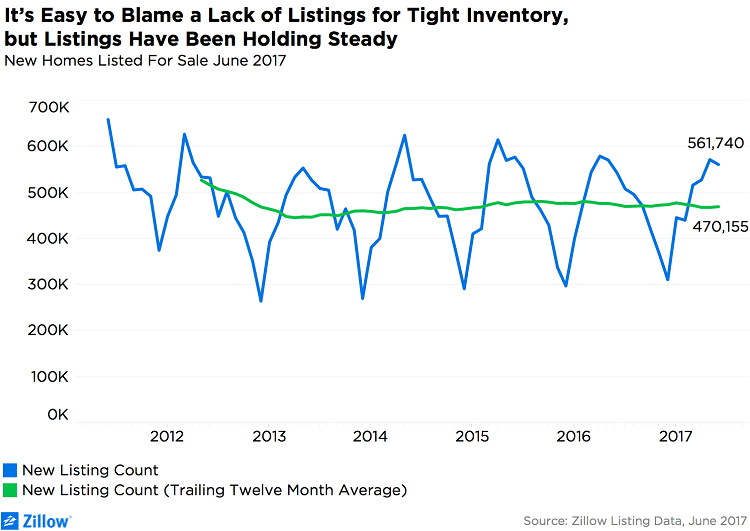
  • Inventory dropped 11.4 percent, but new listings remain relatively flat.

Voracious demand from home buyers coupled with shrinking inventory continues to push the Zillow Home Value Index higher: The U.S. median home value passed $200,000 for the first time ever in June. Inventory is tight and home values are rising, and it’s easy to assume that the main culprit for shrinking inventory is a shrinking number of homes being listed for sale.

Easy, but wrong.

The number of new homes entering the market has been at roughly the same low level throughout the recovery. In June 2017, 561,740 homes were newly listed nationwide – roughly even with the 544,482 homes listed in June 2016 and the 577,821 listed in June 2015.


Why, then, does inventory continue to drop? It fell 11.4 percent nationwide from June 2016. Some markets experienced far greater annual inventory declines: 39.4 percent in San Jose, Calif., 32.9 percent in Columbus, Ohio, and 32.5 percent in San Diego.

The key is not fewer listings, but white-hot demand: Although homes continue to hit the market at roughly the same rate, buyers are snapping them up faster. The median number of days homes are spending on market has trended steadily downward, falling to just 73 days in May – the lowest figure recorded since Zillow began tracking such data and down from 111 days in May 2012. This causes the number of homes for sale at a given point in time to seem especially limited.

The result is home values that continue to climb. The national median home value reached $200,400 in June, up 7.4 percent from June of last year. But while home values keep rising at a breakneck pace, U.S. median rent is growing at a much slower pace – up 1.1 percent from a year ago, to $1,422/month – and actually fell year-over-year in June in 12 of the 35 largest U.S. metros. The Zillow Rent Index fell the most in Pittsburgh (down 4 percent) and Houston (down 3 percent). Miami, San Jose and San Francisco are also among the metros where rent is cheaper this year than last.

Inventory would be even lower if homeowners had pulled back listing their homes for sale. As it is, new listings have been flat – which hasn’t exactly helped frenzied home shoppers struggling with limited selection, but at least listing volume hasn’t fallen. And that represents somewhat of a silver lining for buyers struggling to compete. They should keep their chins up and, more importantly, their eyes open: Odds are roughly as good today as they’ve been in recent years that the home that’s right for them could be listed tomorrow. Buyers just need to be prepared to act faster than ever to get it: To know their budget, to get pre-approved and to work with a knowledgeable and well-connected local real estate agent that can help them get through the process quickly and efficiently.

Facebooktwitterpinterestlinkedin

Sellers Net Highest Profit in a Decade | #SanJoseTopsChart #TalkToYourAgent #SiliconValleyAgent #YajneshRai

Facebooktwitterpinterestlinkedin

Sellers Net Highest Profit in a Decade | Realtor Magazine

Home sellers in the second quarter of this year sold their properties for an average $51,000 more than they paid for them when they bought them. That’s the highest price gain for sellers since the second quarter of 2007, when it was $57,000, according to a new report by real estate data form ATTOM Data Solutions. This represents an average return on investment of 26 percent.

The sellers had owned their homes an average of eight years, which is the longest tenure of homeownership since the first quarter of 2000, when ATTOM Data Solutions began tracking such data. However, “potential home sellers in today’s market are caught in a Catch-22,” says Daren Blomquist, senior vice president at ATTOM Data Solutions. “While it’s the most profitable time to sell in a decade, it’s also extremely difficult to find another home to purchase, which is helping to keep homeowners in their homes longer before selling. And the market is becoming even more competitive, with the share of cash buyers in the second quarter increasing annually for the first time in four years.”

Out of 118 metro areas with at least 1,000 homes sales in the second quarter, ATTOM Data Solutions found that these cities had the highest percentage of sales in which sellers got top dollar:

  • San Jose, Calif.: 75%
  • San Francisco: 65%
  • Seattle: 63%
  • Modesto, Calif.: 62%
  • Denver: 62%
Facebooktwitterpinterestlinkedin

July’s Hottest Housing Markets | #BayAreaTopsAgain #TalkToYourAgent #SiliconValleyAgent #YajneshRai

Facebooktwitterpinterestlinkedin

July’s Hottest Housing Markets | Realtor Magazine

Homes are selling faster in July, and many markets are hotter today than they were a year ago, realtor.com® notes in its newly released housing report. California markets continue to see some of the most traction from home shoppers.

“We normally see the housing market begin to slow down in midsummer, but this year has been a different story,” says Javier Vivas, realtor.com®’s manager of economic research. “Mid- to lower-tier homes are flying off the shelves and … [are] being replaced by higher-priced, larger homes.”

The national median list price in July was $275,000, realtor.com® reports. Further, the National Association of REALTORS® reported this week that 54 percent of existing homes were on the market for less than a month in June.

Vallejo, Calif., once again topped realtor.com®’s list of hottest real estate markets in the country. A growing tech sector, along with more affordable prices compared to its neighboring cities, has helped buoy Vallejo’s housing market. Vallejo’s median home price is $385,000, which is just under 30 percent of San Francisco’s $1.3 million median list price. San Francisco is about a 40-minute drive from Vallejo. 

Homes are selling faster in July, and many markets are hotter today than they were a year ago, realtor.com® notes in its newly released housing report. California markets continue to see some of the most traction from home shoppers.

“We normally see the housing market begin to slow down in midsummer, but this year has been a different story,” says Javier Vivas, realtor.com®’s manager of economic research. “Mid- to lower-tier homes are flying off the shelves and … [are] being replaced by higher-priced, larger homes.”

The national median list price in July was $275,000, realtor.com® reports. Further, the National Association of REALTORS® reported this week that 54 percent of existing homes were on the market for less than a month in June.

Vallejo, Calif., once again topped realtor.com®’s list of hottest real estate markets in the country. A growing tech sector, along with more affordable prices compared to its neighboring cities, has helped buoy Vallejo’s housing market. Vallejo’s median home price is $385,000, which is just under 30 percent of San Francisco’s $1.3 million median list price. San Francisco is about a 40-minute drive from Vallejo. 

Realtor.com® ranked the nation’s housing markets based on how quickly homes are selling as well as the number of listing views they garnered at realtor.com®. The top 20 markets for July are:

  1. Vallejo, Calif.
  2. Kennewick, Wash.
  3. San Francisco
  4. San Jose, Calif.
  5. San Diego
  6. Stockton, Calif.
  7. Columbus, Ohio
  8. Fort Wayne, Ind.
  9. Sacramento, Calif.
  10. Detroit
  11. Dallas
  12. Colorado Springs, Colo.
  13. Yuba City, Calif.
  14. Fresno, Calif.
  15. Waco, Texas
  16. Modesto, Calif.
  17. Denver
  18. Ann Arbor, Mich.
  19. Santa Cruz, Calif.
  20. Santa Rosa, Calif.
Facebooktwitterpinterestlinkedin