What Thieves Are Most After in Homes | #Plan&Prepare #TalkToYourAgent #SiliconValleyAgent #YajneshRai

Facebooktwitterpinterestlinkedin

What Thieves Are Most After in Homes | Realtor Magazine

Here are some sobering stats from the FBI: A robbery occurs every 1.6 minutes in the U.S., a burglary every 18.2 seconds, and a larceny theft every 5.4 seconds.

SafeHome, a home security systems reviews resource, analyzed FBI Uniform Crime Reporting data from 2015 to determine the items thieves most commonly target.

The most stolen items were classified as miscellaneous valuables, jewelry, and precious metals, according to the report. In some states, certain thefts were more common than others. For example, in Florida, Texas, Massachusetts, and Colorado, thieves were more likely to target diamonds, gold, silver, and other jewelry. Meanwhile, clothing was the most stolen items in seven states, including California and Tennessee.

Here are some sobering stats from the FBI: A robbery occurs every 1.6 minutes in the U.S., a burglary every 18.2 seconds, and a larceny theft every 5.4 seconds.

SafeHome, a home security systems reviews resource, analyzed FBI Uniform Crime Reporting data from 2015 to determine the items thieves most commonly target.

The most stolen items were classified as miscellaneous valuables, jewelry, and precious metals, according to the report. In some states, certain thefts were more common than others. For example, in Florida, Texas, Massachusetts, and Colorado, thieves were more likely to target diamonds, gold, silver, and other jewelry. Meanwhile, clothing was the most stolen items in seven states, including California and Tennessee.

Burglary is the unlawful entry of a place, such as a home or office. Burglaries don’t just happen at night, either: The report shows that assailants broke in during daytime hours or evening hours at the same rate. In fact, burglaries that occurred during daytime hours tended to result in a higher loss than those that occurred at night, according to the report.

Burglary is the unlawful entry of a place, such as a home or office. Burglaries don’t just happen at night, either: The report shows that assailants broke in during daytime hours or evening hours at the same rate. In fact, burglaries that occurred during daytime hours tended to result in a higher loss than those that occurred at night, according to the report.

Facebooktwitterpinterestlinkedin

Foreign Investment in the U.S. Homes Soars: Report – Mansion Global | #ForeignersInvesting #TalkToYourAgent #SiliconValleyAgent #YajneshRai

Facebooktwitterpinterestlinkedin

Foreign Investment in the U.S. Homes Soars: Report – Mansion Global


1. China

2. Canada

3. UK

4. Mexico

5. India


Foreign investment in U.S. residential real estate jumped nearly 50% over the past year compared to the year prior thanks to a bump in Canadian purchases, according to an annual report from the National Association of Realtors.

In total, the group estimates non-citizens, including permanent residents and non-permanent buyers, spent $153 billion on U.S. homes between April 2016 and March 2017, up 49% from the 12 months prior, according to the report released Tuesday. Chinese, Canadians, British, Mexicans and Indians made up the top five buyers of U.S. homes—and all of these groups increased the amount of money spent on homes compared to the year before.


The association bases its data on an annual survey conducted each spring, to which 6,000 realtors responded in 2017. The survey asks about closed transactions in the previous 12 month period.

The reported jump in foreign purchases runs contrary to expectations, especially given the very strong dollar compared to most foreign currencies, said Lawrence Yun, the association’s chief economist.


“That was surprising since the strong dollar would have made it more costly,” Mr. Yun said. He speculated that foreigner buyers, like Chinese and Canadians—who come from countries where property values have grown exponentially over the past year—are using their appreciated housing equity in their home countries to buy second homes in the United States.

Of all foreign purchases in the U.S., around 10% were for homes priced at $1 million or more.

Canadians buy despite dollar strength

In Toronto, for example, the average sales price increased 24.5% in the year to April 2017, the same period tracked in the association’s report, according to figures from the Toronto Real Estate Board.  

Foreign home buyers in the U.S. have been most active in Florida, California and Texas. Florida alone accounted for 22% of foreign activity, fueled a great deal by an upswing in Canadian buyers.

Canadians have been the single biggest foreign buyer in the Fort Lauderdale market, according to a broker with the Realtors Association of Greater Fort Lauderdale.


The National Association of Realtors estimates that Canadians have more than doubled the amount of money they’ve spent on U.S. residential real estate, from $8.9 billion between April 2015 to March 2016 to $19 billion in the following 12-month period. That jump has happened in spite of the weakening Canadian currency, which is now about 70 cents to every U.S. dollar.

The draw of tropical climates and pools in the southern U.S. may be enough to overcome an unfavorable exchange rate.

“To a Canadian, palm trees are just about heaven,” said Diane Brennan, a Canadian-American broker with Coldwell Banker in Scottsdale, Arizona. The greater Phoenix area was a huge magnet for second home buyers from western Canada in the post-recession years until the price of oil collapsed.

Some Canadians are still buying in Arizona, but the bulk of activity is now Canadians selling their Arizona homes to benefit from the “double bang” of value appreciation and the other 30% they get from bringing U.S. dollars back to Canada, Ms. Brennan said.

Chinese remain top buyers in U.S.

The influx of Canadian buyers failed to unseat the Chinese as the biggest buyers of U.S. real estate for the fourth year in a row, according to the National Association of Realtors.

The Chinese spent $31.7 billion in U.S. residential real estate between April 2016 and March 2017— despite new government controls in China to keep money from leaving the country, the association reported. While Mr. Yun said California continues to be the primary destination for Chinese buyers, local brokerages said they haven’t seen any remarkable uptick in Chinese activity.

“The Chinese are the major players in foreign home buying in California, but I do have the tendency to think reports of their buying are exaggerated,” said Patrick Carlisle, chief market analyst at Paragon Real Estate Group.

“When someone buys real estate, there’s no requirement to record whether they are a citizen or not, so all the information about Chinese home buying in the U.S. is anecdotal,” he added.


Chinese buyers have traditionally bought homes in new condo developments in the Bay Area, and made considerable investment around colleges like Stanford University, where they buy homes for their children to live in.

Controls on Chinese capital outflows may already be cooling their purchases, according to the National Association of Realtors, which said that local brokerages are reporting fewer foreign buyers in 2017.

“It appears much of the activity occurred during the second half of 2016,” Mr. Yun said. “Realtors in some markets are reporting that the effect of tighter regulations on capital outflows in China and weaker currencies in Canada and the U.K. have somewhat cooled non-resident foreign buyer interest in early 2017.”

Facebooktwitterpinterestlinkedin

Most Expensive Purchases of a New Homeowners | #CanYourRelate #TalkToYourAgent #SiliconValleyAgent #YajneshRai

Facebooktwitterpinterestlinkedin

Most Expensive Items New Homeowners Buy | Realtor Magazine

Furniture, appliances, and remodeling projects are among the biggest expenses for new homeowners, who spend an average of $10,600 in the first year of homeownership, according to a recent analysis by the National Association of Home Builders. New owners spend an average of $3,778 on furnishings alone, according to NAHB’s analysis. Here are a few common expenditures recent home buyers made:

  • Living room chairs and tables: $687
  • Dining room and kitchen furniture: $345
  • Window coverings: $215
  • Sofas: $700
  • Property alterations and repairs (particularly outdoor additions and alterations such as a new driveway, walkway, or fence): $3,729
  • Appliances (particularly washers and dryers, lawnmowers and other yard equipment, and computer hardware and systems): $3,094

“The high level of spending by new home buyers may seem surprising—considering that many new homes come with installed appliances—but suggests that these purchases are nevertheless more frequent among these households,” the NAHB notes on its blog, Eye on Housing. A survey conducted by Home Innovation Research Labs shows that two-thirds of new homes built in 2015 came with no washer or dryer; 36 percent had no refrigerators. Most new homes, however, did come with cooking stoves, ranges, and ovens.

Facebooktwitterpinterestlinkedin

You can help your roof last longer | #RoofMaintenanceTips #TalkToYourAgent #SiliconValleyAgent #YajneshRai

Facebooktwitterpinterestlinkedin

You can help your roof last longer

Here are a few questions from our readers that I think you will find interesting.

QUESTION: My roof is getting old and it won’t be long before I need a new one. I know roof replacement is expensive. Is there anything I can do to prolong its life expectancy and put off having to replace it for a while?

ANSWER: Yes, there is.

First, if you know when the roof was installed remember that a standard 3-tab roof shingle has an average approximate 20-year life expectancy. The newer dimensional shingles last longer. Also keep in mind that shady environments have the tendency to shorten the life expectancy while sunny environments increase it.

Add to the above that the weak spots in the roof that are sensitive to leaking and failure are seams and valleys, ridge cap (the shingles at the very peak of the root), lower shingles near the gutters and most often penetrations through the roof (chimney, vent pipes, skylights, etc.). Older shingles have the tendency to get brittle as they age. I have seen some homeowners go up there on an older roof to make repairs and cause more damage than they fixed because they were not careful where they were stepping.

Here are some things you can do or hire to have done to extend the life expectancy of your roof.

Cut back overgrowth. No leaves, vines or branches should touch your roof or create excessively shaded areas.


Remove any debris from the roof surface such as; dead branches, pine needles, leaves, etc. You want your roof to be exposed to sunlight and air movement.

Clean your gutters so that they can shed water and ice off the surface as intended.

Remove any excessive moss build-up caused by shady conditions if necessary (although sunlight will lessen and dry moss once you cut back the overgrown trees). There are moss removal products that are easy to apply available at your hardware or builders supply.

Replace or repair any damaged, crooked or missing shingle tabs that may have been impacted by past high winds.

Check and repair the ridge cap shingles that have the tendency to show irregularities more often than the flat areas.

Check the valleys and lightly re-tar or seal any damaged, cracked or openings discovered.

Finally, thinly re-seal plumbing stacks, roof vents, chimney flashings and other penetration that shows wear, openings, separation, peeling or drying out.


You will note that above I stated “lightly re-tar” and in another item stated “thinly re-seal.” Roof sealing adhesives typically work more effectively when not over-applied. When there is too much of the sealant product it has the tendency to shrink, contract and crack faster. The thinner the application, the more elasticity the material has and it will usually last longer.

Just for the record, last year I had the same concern on my roof and hired a licensed contractor (roofer, builder or carpenter). Two of his employees came out, spent about 3 hours on the roof. It cost a few hundred dollars and hopefully I will get several more years out of my roof shingles.

QUESTION: I have a big brick chimney on my house. I just noticed that the bricks near the top have these white stains on them. Is this something I should be concerned about and if so what should 1 do?

ANSWER: Yes, it is something you should be concerned about.

Those white stains are called “efflorescence” and are an indication that water, snow and ice are penetrating the top of the chimney and saturating the bricks below. Over time, these wet bricks will become damaged from the expansion and contraction caused by freezing and thawing weather.

Bricks are not impervious to damage and certain softer types are more prone to this condition.

At the very top of the brick on the chimney there is either a fieldstone cap or more commonly (and less expensive) a bed of concrete tapered at the perimeter edges to encourage water runoff. These concrete caps are called ”coping.”

You noticed that I said “bed of concrete” and not the mortar that the masons use to lay the brick. The reason for this is because concrete is harder than mortar and more resistant to cracking. Often mortar is actually used in this area accidentally and will need repair sooner.

The top of your chimney needs to be re-sealed with a thin layer of an appropriate product. You may want to have a licensed “chimney sweep” perform the task who can simultaneously check the inside of the chimney, remove any debris and clean it if necessary. They are more comfortable with the high ladders needed, have the equipment on hand, do the job quickly and prevent more expensive repair. Also make sure that anyone you hire is insured. This is considered a hazardous task. Good luck.

Facebooktwitterpinterestlinkedin

Mortgage Rates On the Rise | #LockInRates #TalkToYourAgent #SiliconValleyAgent #YajneshRai

Facebooktwitterpinterestlinkedin

Mortgage Rates Push Above 4% Average | Realtor Magazine

Average mortgage rates are moving up, posting increases for the second consecutive week.

“After fully absorbing the sharp increases in Treasury yields over the past couple of weeks, the 30-year mortgage rate has cleared the psychologically important 4 percent mark for the first time since May,” says Sean Becketti, Freddie Mac’s chief economist.

Freddie Mac reports the following national averages with mortgage rates for the week ending July 13:

  • 30-year fixed-rate mortgages averaged 4.03 percent, with an average 0.5 point, increasing from last week’s 3.96 percent average. Last year at this time, 30-year rates averaged 3.42 percent.
  • 15-year fixed-rate mortgages averaged 3.29 percent, with an average 0.5 point, increasing from last week’s 3.22 percent average. A year ago, 15-year rates averaged 2.72 percent.
  • 5-year hybrid adjustable-rate mortgages averaged 3.28 percent, with an average 0.5 point, rising from last week’s 3.21 percent average. Last year at this time, 5-year ARMs averaged 2.76 percent.
Facebooktwitterpinterestlinkedin

Highest and Lowest Energy Bills in the U.S. | #InterestingEnergyFactsCA #TalkToYourAgent #SiliconValleyAgent #YajneshRai

Facebooktwitterpinterestlinkedin

Highest and Lowest Energy Bills in the U.S. | Realtor Magazine

Homeowners are bracing for the July heat as they prepare for some of their steepest utility bills.

Energy costs in the U.S. consume from 5 to 22 percent of families’ total after-tax income, according to a new analysis by WalletHub, a financial resource.

“And lower energy prices don’t necessarily equate to savings,” WalletHub notes in its study. “Where we live and how much energy we use are a big part of the equation.”

For example, electricity tends to be cheaper in sweltering Southern Louisiana than in Northern California, even though heating and cooling units aren’t needed as much in many areas of the Golden State.

WalletHub compared the total monthly energy bills in each of the 50 states and the District of Columbia. The analysis accounted for residential energy use of electricity, natural gas, motor fuel, and home heating oil.

Most Energy-Expensive States

  • Connecticut: $380 (total energy cost)
  • Alaska: $332
  • Rhode Island: $329
  • Massachusetts: $327
  • Wyoming: $320
  • Georgia: $310
  • Maine: $308
  • Mississippi: $307
  • New Hampshire: $306
  • Vermont: $305

Least Energy-Expensive States

  • District of Columbia: $219 (total energy cost)
  • Washington: $226
  • Colorado: $228
  • Oregon: $246
  • Illinois: $247
  • Iowa: $251
  • Nebraska: $253
  • New Mexico: $256
  • California: $257
  • Arizona: $257
Facebooktwitterpinterestlinkedin

The Best Paint Color to Sell a Home | #PaintColors #TalkToYourAgent #SiliconValleyAgent #YajneshRai

Facebooktwitterpinterestlinkedin

The Best Paint Color to Sell a Home | Realtor Magazine

Lure potential buyers with a simple and clean palette. Shades of white and off-white are the top colors for a quick home sale, Jody Finglas of Finglas Painting in Ossining, N.Y., told USA Today.

“White is the foundation that anchors the home,” adds Friley Saucier, a broker-associate with Sotheby’s International Realty in Naples, Fla. “This is absolutely what is most requested when I’m working with home buyers.”

Finglas says less is more. “We’re seeing a lot of requests for lighter, brighter colors,” he notes.

When working with a white backdrop, the trick is to add in color through the furnishings and accessories, Finglas says. He says selecting the right shade of white paint isn’t easy. “A white kitchen can mean 40 different colors,” Finglas says.

Homeowners should still bring home paint swatches, says Dwayne Bergmann of Dwayne Bergmann Interiors in Fort Myers, Fla.

“Whites can have a more blueish hue or more of a brown or even pinkish hue depending on the exact lighting,” Bergmann says. “Even a pure white is going to look different.”

Facebooktwitterpinterestlinkedin

4 Common Home Buyer Slip-Ups | #HomeBuyerTips #TalkToYourAgent #SiliconValleyAgent #YajneshRai

Facebooktwitterpinterestlinkedin

4 Common Home Buyer Slip-Ups | Realtor Magazine

Real estate professionals see a lot of dumb reasons why home buyers ultimately end up losing out on a deal. Practitioners recently shared some of the more common mistakes with realtor.com®, including ways to correct the situation:

1. Shopping outside their price range.

“It sounds obvious, but some home buyers just have trouble sticking to a budget,” says Benny Kang, a real estate professional in Irvine, Calif. Shopping online may increase the temptation to bump up the price range. One way to avoid this situation is to encourage your buyers to get preapproved for a loan so they know what they can truly afford and stay within their limits.

2. Submitting lowball offers in a hot market.

“If you’re in a seller’s market, making a crazy lowball offer can piss off the seller,” says Kang. Buyers would be smart to offer full price when homes are priced well. Help buyers understand how a comparative market analysis can offer insight into pricing.

3. Making a big purchase while in escrow.

Buyers often don’t realize they will need to delay big purchases and opening new credit lines while in the process of buying a home. “Even buying a fridge can throw off your credit or debt-to-income ratio,” says Kathy Conway, a Philadelphia real estate professional. If a big purchase is made, the mortgage lender’s underwriter will need to re-evaluate the buyer’s finances and recheck her credit report before closing to ensure the buyer still qualifies for the mortgage, so be sure to warn buyers when they’re approaching this period.

Download this worksheet that will help your clients calculate closing costs and customize it with your branding. 

4. Forgetting to budget closing costs.

Buyers don’t just need money for the down payment. There are a lot of extra fees at settlement, too. Buyers can receive an estimate from their mortgage lender of what the closing costs will be before even making an offer on a property. Make sure they review that information carefully. Closing costs can vary drastically but typically cost 2 to 7 percent of the home’s purchase price.

Facebooktwitterpinterestlinkedin

Rising Mortgage Rates Affect Home Affordability, But Less Than You Think | #InterestRatesEffect #TalkToYourAgent #SiliconValleyAgent #YajneshRai

Facebooktwitterpinterestlinkedin

Rising Mortgage Rates Affect Home Affordability, But Less Than You Think | Mortgage Rates, Mortgage News and Strategy : The Mortgage Reports

Rising Mortgage Rates & Home Affordability

Rising mortgage rates do affect home affordability. If you’re shopping for real estate, the recent interest rate increases might be a concern.

However, the relationship between home affordability and interest rates is more complicated than that, and the news may not be as bad as you think.

Whether you’re buying or refinancing, now is a great time to shop for a home loan.

Click to see today’s rates (Jul 11th, 2017)

Lower Rates Mean Lower Payments… And More

For good reason, everyone wants to get the lowest rate possible. Lower interest rates have several implications for home buyers:

  • Ability to purchase more house (you can qualify for a larger loan)
  • Lower monthly mortgage payment
  • Competition for homes as would-be buyers jump on cheap financing

Consumers: Maybe Mortgage rates Won’t Rise After All

The mortgage rate you secure not only impacts your monthly housing budget, it also affects your purchasing power — the amount of home you can buy with the budget you have.

Naturally, the question today for most homebuyers is this – if rates go up, how much house can I afford on my salary?

Mortgage Rates Forecast

As we officially hit the halfway mark in 2017, against analyst’s predictions, mortgage rates have not climbed to 4.5 percent or higher.

On the contrary; according to a report released by Freddie Mac last week, 30-year mortgage rates fell two basis points to 3.88 percent. And many experts now think rates will remain below five percent for some time.

How Rising Mortgage Rates Affect Your Payment

However, because rates are trending higher over time, it’s important to understand the effect rising rates has on your affordability.

If the house you want is at the top end of what you can afford to buy, incremental rate increases can derail your purchase.

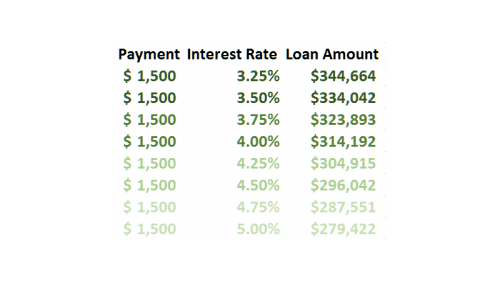
With each quarter percent increase in interest rate, the amount you can finance drops by roughly 2.5 percent.

Better Deals On New Homes Because Of This Emerging Trend

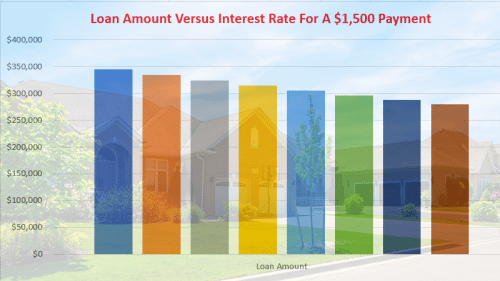
For example, let’s say that you and your lender determine that you can comfortably afford a principal and interest payment of $1,500 per month. The chart below shows how the interest rate for your loan program determines your maximum loan amount.

home affordability

loan amount versus mortgage rate

However, here’s an interesting fact that many homebuyers are pleasantly surprised to find out.

Your Payment May Not Increase By Much 

Contrary to popular belief, a 1/4th percent higher interest rate doesn’t necessarily mean you are now way over budget, or that you can no longer qualify for that dream home.

Using today’s median U.S. home is valued at $199,200 as an example, let’s say you’re buying a $200,000 home and putting 10 percent down – per the National Association of Realtors, homebuyers financed 90 percent on average in 2016.

Using that average down payment of 10 percent, that means you would be financing $180,000. Let’s say your mortgage is 3.875%. Using these factors, that means your principle and interest payment would be $846 per month.

Should I Buy A House Or Rent?

Now, let’s say rates go up by 1/4th of a point to 4.125%. Using the same scenario, your new principle and interest payment would then be $872 per month.

The increase to your payment is less than $26 per month for that one quarter percent rate increase. Not to say this increase doesn’t add up over the years, but most homebuyers are pleasantly surprised to find out they can still afford that dream home even with the slightly higher rate increase.

Higher Rates May Be Offset By Lower Prices

While mortgage interest rates will always have a major influence on the ability to purchase a home, there’s another substantial factor to consider. This factor may even be bigger than mortgage rates – inventory.

Harvard Research: The Future of Home Prices In 2017 And 2018

Largely due to the laws of supply and demand, the lack of available inventory tends to push home prices up, making your ability to buy a home more challenging. This is especially true for first time home buyers.

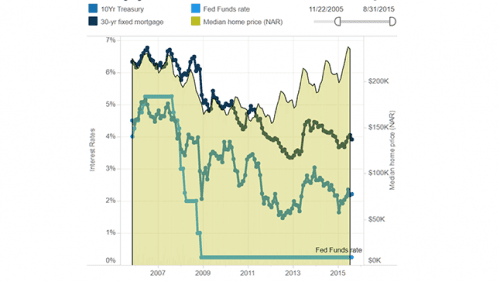
However, in areas where inventory is balanced with demand, increasing mortgage rates tend to push home prices down. In a CNBC article,  real estate consultant John Burns analyzed the relationship between mortgage rates and home prices, assuming the rate for a 30-year fixed mortgage would eventually increase to six percent, from recent levels of about four percent.

home affordability when rates rise

The result is that some overcooked markets like San Francisco, Silicon Valley, and Miami, could be overvalued by over 20 percent.

But in markets where housing prices are more normal, prices are still undervalued. And that’s even if mortgage rates move back up to six percent. Those undervalued markets include Chicago, Atlanta and Detroit.

Mr. Burn’s chart shows the historical relationship between rates and prices in the US.

Facebooktwitterpinterestlinkedin

Aspects of a Home, Buyers Shouldn’t Overlook | #HomeBuyingTips #TalkToYourAgent #SiliconValleyAgent #YajneshRai

Facebooktwitterpinterestlinkedin

Aspects of a Home Buyers Shouldn’t Overlook | Realtor Magazine

After moving in, buyers will discover a lot about their new home—but they may wish they had paid closer attention to some items before signing the sale contract. Help your clients avoid regrets by guiding them to assess a property carefully before purchasing it. Realtor.com® advises giving particular consideration to these areas:

Nighttime atmosphere. Advise your clients to view a home at different times of the day and night. “A community can change drastically when everyone is home from work and school,” says Aaron Norris of the Norris Group in Riverside, Calif. For example, Norris says he learned after purchasing his own home that college students pack into nearby houses and party on the weekends.  

The commute. Buyers should test the morning and evening drive between their potential home and work. Does traffic make it difficult for them to get to work on time? Your clients should know whether the location of their home will require them to leave earlier in the morning.

Homeowners association rules. If the home your client wants to buy falls under a homeowners association, encourage them to review a copy of the bylaws. The association’s conditions, covenants, and restrictions describe regulations around what homeowners can do with their property. You’ll also learn what neighbors are allowed to do—in case, for example, your client is uncomfortable living next to a home that is being rented out.

The need for specialty inspections. The home may contain items that need to be assessed by specialists who go beyond a general inspection. For example, if the property contains a septic system, well, or solar panels, your buyer may want a special evaluation.

Facebooktwitterpinterestlinkedin