Ventilation Is the ‘New Frontier’ for ‘Healthy’ Homes | Realtor Magazine
Indoor air quality is one of the top five environmental risks to public health, researchers say. After all, most people spend 90% of their time indoors, whether in homes, office buildings, or other structures. Ventilation is the “new frontier for making houses healthy,” Carl Seville of SK Collaborative, a green building consulting and certification firm, told Forbes.com in a recent article.
There’s reason for the added attention. Recent studies have shown indoor air is polluted with lead, dust mites, radon, pests, carbon monoxide, pet dander, mold, and secondhand smoke, according to the National Environmental Education Foundation. Ventilation in the form of bathroom fans and kitchen range hoods can help remove some of the bad air from homes. Older homes, however, may be prone to leaks of these pollutants.
Some homeowners are taking it to the extreme to purify their home’s air. For example, a new 9,500-square-foot home in San Francisco was built in 2018 by Troon Pacific and boasts hospital-grade air filtration via a Zehnder whole-house ventilation system. It changes all of the air in the home every two hours. Also, a whole-house vacuum system ensures all areas are allergen- and dust-free. The system costs around $10,000. Builders also are constructing newer homes more tightly than they did in the past. As such, newer homes may be more energy-efficient, but their tightness may be keeping fresh air out.
Some homeowners are turning to heat recovery ventilation and energy recovery ventilation systems. They both essentially pull out bad air and replace it with good air using different methods. HRV systems run between $600 to $1,100 for a mid-size system; similar-sized ERVs may cost $150 to $200 more, according to Forbes.com.
Real estate professionals know how to look at houses from a buyer’s perspective and can spot decor trends that are likely to turn their clients off. “I am selling space, and I need to be sure that the spaces are not distracting and that the buyer does not have to work too hard to take in the overall size, proportion, and scale of a room,” Robin Kencel of Compass told Apartment Therapy.
Some of today’s most popular design trends could prove to be less than ideal for your buyers. Real estate pros tell Apartment Therapy which interior design trends they believe won’t impress potential buyers—and may even make them want to pass on a home, including:
Colorful kitchens. The trend towardbold colors in the kitchen, rather than just white or neutral colors, is catching on. But real estate pros don’t believe that most buyers will warm up to this hot trend. Bright kitchen cabinets and appliances—in hues of reds, greens, or blues—can be polarizing, they say. “When that owner goes to sell his/her [home] years down the road, the next owner will likely reject that customization and will have to rip out and install a new kitchen, even if the cabinets and appliances are in great condition,” June Gottlieb, an agent with Warburg Realty, told Apartment Therapy. Gottlieb believes neutral appliances and cabinetry still are the true favorite of home buyers.
Taxidermy. The art of stuffing and mounting animals on the wall may offend some buyers. “While it might be natural for a decorator to include taxidermy into the room decor, I always recommend removing any once-living animals from a room before the house gets listed,” Kencel says. “I have seen buyers physically recoil and refuse to enter a room that has taxidermy in it.” The same thing applies to fur accessories and animal skin rugs; some buyers may be sensitive to their use as well.
Bold contrasts. The black-and-white trend in home decor is catching on, but real estate pros told Apartment Therapy they don’t believe it works when showing off a home for sale. “While some might like this bold look, it is really not for everyone,” says Kathryn Landow of Warburg Realty. Black-and-white marbled entries, accessories, and color blocking in cabinetry can prove to be a little much. Any use of the black-and-white trend is best kept to decorative accents, real estate pros say. Those are much cheaper to swap out than tile or marble flooring or kitchen cabinetry.
When it comes to first impressions, the little things make all the difference.
Planning to sell your house this year? Now’s the perfect time to prep it for listing!
Set aside a couple of weekends to do the work, and follow these three steps. Then, get ready to make a great impression on potential buyers and cinch the deal.
Step 1: Clean and declutter
It may sound obvious, but the importance of cleaning and decluttering cannot be overstated. Here are some ideas to make this process nearly painless.
Eliminate clutter before cleaning: This is the time to purge your house of unwanted and unnecessary items. In addition to donating items to charity, consider giving them away through Craigslist or neighborhood sharing groups. Recyclers are often willing to pick up and haul away large metal items for free.
Deep clean your house: This step will probably involve the biggest time investment. Get the whole family involved if you can! Think of this as a pumped-up spring cleaning. Pay special attention to kitchens and bathrooms, and clean the inside and outside of your windows — this makes a striking improvement in the overall appearance of your house.
Organize closets, cabinets and drawers: In this case, out of sight is not out of mind. Many potential buyers will open cabinets and closets, because they are thinking about storage space. Clean and organized storage areas signal to buyers that you take care of the house.
Step 2: Make small repairs
Take care of these problems before you show the house for the first time. These are all fixes that you can do yourself.
Fix any leaking faucets and running toilets.
Replace caulking around tubs, showers and sinks.
Freshen up or repair grout as needed.
Repair walls and repaint them in a neutral, generally pleasing color that complements your home.
Fix cracked or broken windows.
Replace or repair damaged window screens.
Replace burned-out lightbulbs.
Step 3: Go for curb appeal
You want potential buyers to be charmed by the outside of your house so they look forward to coming inside. Extend your pumped-up spring cleaning to the outside of your house too.
Trim bushes, shrubs and trees. Make sure vegetation isn’t touching your roof or siding.
Repair broken downspouts and gutters.
If it’s appropriate for your yard, apply new mulch, river rock and/or pea gravel. This can do wonders for your landscaping and provide immediate curb appeal.
Clean and repair concrete areas, such as driveways and walkways. Eliminate any oil or grease stains, and clean out any weeds coming up through the cracks.
If it’s seasonally appropriate, put out some pots of annuals, which will maintain their color for the season. Freshen up your doorstep with a new welcome mat and make sure the house numbers are easy to see.
With just a moderate amount of effort, you can make your house beautiful and welcoming, both inside and out.
Home buyers are reaping some of the lowest borrowing costs in years this buying season. The 30-year fixed-rate mortgage remained unchanged from last week at 3.82%, which matched last week for the lowest average since September 2017.
“Mortgage rates were mostly unchanged from last week due to easing of trade tensions with Mexico, which helped stabilize markets,” says Sam Khater, Freddie Mac’s chief economist. “These historically low rates should provide continued opportunities for current homeowners to refinance their mortgages—which combined with new home buyer activity—will help sustain the momentum in the housing market in 2019.”
Freddie Mac reports the following national averages with mortgage rates for the week ending June 13:
30-year fixed-rate mortgages: averaged 3.82%, with an average 0.6 point, unchanged from last week. Last year at this time, 30-year rates averaged 4.62%.
15-year fixed-rate mortgages: averaged 3.26%, with an average 0.5 point, dropping from last week’s 3.28% average. A year ago, 15-year rates averaged 4.07%.
5-year hybrid adjustable-rate mortgages: averaged 3.51%, with an average 0.4 point, falling from last week’s 3.52% average. A year ago, 5-year ARMs averaged 3.83%.
A termite infestation can be costly, and sadly, many homeowners don’t discover there’s a problem until these wood-eating pests have already caused a great deal of damage to a home or an inspection uncovers it during a home sale.
“Termites are referred to as the hidden enemy,” says Mike Duncan, an associate certified entomologist and eastern region trainer for Truly Nolen, a pest control company. The damage can reach $7,900 or more before they’re found, Duncan told realtor.com®.
Some homeowners may be unknowingly attracting termites to their homes. An article at realtor.com® recently flagged some ways owners may be creating a termite spot, beyond just rotting wood.
For example, even the tiniest bit of moisture, such as from poor drainage, leaks, or poor ventilation, along with wood can be a big draw for termites. “Because they consume the cellulose in wood for nutrition, they require high moisture so that they don’t dry out,” Natasha Wright, a board-certified entomologist and technical director for Braman Termite & Pest Elimination in southern New England, told realtor.com®. Soggy soil near your foundation can also be a big draw to termites.
Don’t assume stucco houses are safe either. Termites are drawn to the protection from foam board insulation and exterior wall solutions, like Dryvit, a synthetic version of cement siding, Wright says. “They will chew through and travel in these sheltered areas until they stumble upon wood,” Wright says.
Cracks in a foundation can be another way termites can enter. “Should they find cracks or gaps, termites may investigate and enter,” says Mike Deutsch, an urban entomologist for Arrow Exterminating Co. in New York. “They may eventually intercept wooden members of the structure and begin to feed, causing damage.”
Be on the lookout for mud tubes, soft or hollow-sounding wood, and visible piles of wings, experts say. “These are signs that you have a termite problem,” says Erin Richardson, president of All-American Pest Control in Nashville, Tenn.
Call in a professional to investigate further and to remedy the situation if you suspect termite problems.
Renters are unlocking savings on their federal taxes, and a real estate watchdog believes that will translate into greater home sales. The Tax Cuts and Jobs Act may well fuel an increase in entry-level home buying in most areas of the country, according to a newly released report from John Burns Real Estate Consulting.
Renters paid $2,716 less in taxes on their 2018 federal tax bill across some of the top housing markets (ranging from $1,918 less in places like Miami to $5,214 less in San Jose, Calif.). Renters do not have deductible mortgage interest or property taxes that could help qualify them for itemizing, the study notes. This increased standard deduction and lower taxes helped create additional income for renters. As such, they may be able to save up to branch out sooner into homeownership, the authors note.
Further, “entry-level homes will continue to outperform,” the report reads. “Low unemployment, sound economic and demographic fundamentals, and stretched affordability support strong entry-level housing demand.”
The report also is bullish on greater migration heading to the South, with more residents leaving higher-taxed coastal areas in favor of more affordable areas. Low-tax states should continue to see immigration from other states and strong housing demand, while emigration is accelerating in California, New York, New Jersey, and Illinois. “The [Tax Cuts and Jobs Act] did not create these trends but has amplified them,” the report notes.
The Tax Cut and Jobs Act overhauled the U.S. tax code in 2017 and placed caps on certain deductions for homeowners. The tax law placed a $10,000 cap on deductions of state and local taxes, increased the standard deduction, and placed a $750,000 limit on the amount of mortgage debt that qualifies for interest write-offs.
However, homeowners across the country still found some savings on their 2018 federal tax bill, too. Homeowners saved an average of $1,508 on their tax bill, the study notes. The increased standard deduction of $24,000 exceeded the total state and local tax deduction and mortgage interest deduction in many households. “Most homeowners don’t benefit from itemizing currently; however, this has been the case for the last decade,” John Burns Real Estate Consulting notes.
PPG, a paint firm and color forecaster, released its early picks of inspiring hues for 2020. If the predictions are right, you’ll be seeing much more blue in home decor next year. PPG announced on Monday that Chinese porcelain is its 2020 color of the year.
The shade is a blend of cobalt mixed with some muted navy tones intended to instill calmness and restful sleep, the paint firm says. Blues have been steadily gaining popularity overall in residential and hospitality design.
“Consumers are tiring of stark grays and are looking to infuse colors that delight the senses,” says Dee Schlotter, senior color manager at PPG. “Blue is the easiest possible entry point from the world of neutrals to the world of color.”
Blue can be used as a color pop but can also serve as a neutral shade. It can be used as a feature color in a bedroom when set against crisp white bedding and crown molding for a sharp contrast. In the living room, for a modern look, blue can be layered with tufted and velvet furniture or paired with metallic finishes, the paint firm suggests.
Schlotter also recommends the pairing of the Chinese porcelain hue with decor such as lush drapes or velvet pillows in warm saffron and turmeric tones. The blue color also can be paired with leather accents and dusty sand tones for an attention-getting look, she notes.
Spaces are getting more colorful and that trend will likely continue in 2020, color forecasters say. PPG suggests several trending color combos, such as its brilliant blue, Turner’s yellow, and bleeding heart for a bolder look. Also, it notes color combos that reflect earthiness featuring raw, natural hues mixed in with bolder tones, such as its cinnamon spice and brown clay combined with organic, oxidized blue-greens like celestial blue and summer breeze.
A Louisiana woman was arrested last week after a real estate professional reported to police that she was attempting to purchase a million-dollar home with fake income verification documents. Pamela Chandler, who was trying to buy the property in Benton, La., presented the agent with a document claiming she had access to a trust fund. But after researching the document, the agent believed the paperwork was fake and reported it to the Bossier Financial Crimes Task Force.
Police arrested Chandler on forgery charges; the task force alleges that Chandler altered a letter from an attorney to make it appear as though she had access to sufficient funds to purchase the home. Chandler faces two counts of forgery as well as outstanding warrants in Texas on unrelated charges of fraud and exploitation of children, elderly, or the disabled.
“Through the course of the investigation, task force members found that Chandler altered a letter from an attorney in an attempt to lead the REALTOR® to believe that she had access to sufficient funds to purchase the home,” city officials said in a statement. “The investigation also found that Chandler had used multiple aliases in the past, including the Goldwyn name. Taskforce members secured a warrant for Chandler’s arrest and worked with the REALTOR® to take her into custody.”
Chandler is being held at the Bossier Parish Jail.
At an open house, buyers will carefully size up a home, either to buy or simply out of curiosity. Here are a few details to pay particular attention to when prepping for an open house:
The front door: This is the first spot buyers see. Is the paint chipped? Are the lighting fixtures covered in spiderwebs? The front door could set the tone for the rest of the house on whether this is a well-kept house or one that lacks maintenance, Elizabeth Lucchesi, a real estate pro with the LizLuke Team with Long & Foster Real Estate in the Washington, D.C., area, told The Washington Post.
The smell: Every home has a scent, whether good or bad. Homeowners can become nose blind to the scent that their home is projecting. But new people coming in will notice.
Maintenance signs: Lucchesi suggests looking at the house carefully for any signs that show it hasn’t been properly maintained. For example, is there peeling paint on the trim outside? Is the house showing its age, such as with the appliances and countertops? Address any needed repairs or maintenance issues.
Plumbing: Visitors are undoubtedly going to open that cabinet under the sink. Is there any evidence of leaking under the sinks? Make sure the plumbing is up to par.
Windows: Are the windows foggy? If so, that’s a giveaway there’s a problem with the sealing. Lucchesi says make sure the windows open and close properly in an older home and that there are no other issues they present.
First impressions are everything, especially in home buying. A gorgeous exterior vs. a crummy one decides whether you walk in the front door. Inside, spotless interiors are more likely to inspire a life there than a cluttered house that’s clearly, well, someone else’s home.
And while this is where staging can play a huge role, it’s the listing pictures buyers see online that is often the first barrier of entry. So they better be really good.
In fact, a 2013 Redfin study found that homes professionally photographed with high-performance Digital Single-Lens Reflex (DSLR) sold quicker and for thousands of dollars, more than homes shot with amateur photos. DSLR cameras are also the preferred camera of Redin’s national photography manager, Drew Larrigan. Redfin provides professional photography to all its listing clients, free of charge.
Why Professional Real Estate Photos Sell Homes for More
“The iPhone is the number one camera on the market right now, but we are still very far from it replacing a DSLR, which offers a higher quality image with higher pixelation. It’s the level necessary in this business, that will be continued to be used in the market for years to come.”
But you need more than just a fancy high-tech camera, you also need the know-how.
“The number one thing people get wrong with listing photography is having the mindset that anyone can do it and deliver a beautiful photo,” he said. “There is a lot of behind-the-scenes work you don’t see, capturing layers of High Dynamic Range (HDR) images to create one beautiful shot.”
Layers, he explained refers to multiple exposures. “This allows us to highlight shadows and bring out brightness or darkness through the windows. And then you stack those layers, which creates the beautiful windows in our photos.”
As online searching and browsing is a critical part of the home-buying process, it makes sense that professional photos will entice people to visit the home as they know what they are getting before they even set foot in the home.
“Today we have more shoppers buying from abroad or out of state and making an offer sight unseen, and really want to see a home documented,” Drew said. “They want to see every corner of the home, and that’s the beauty of the DSLR is offering a resolution that allows the out of state or city buyer a chance to see the home in full.”
Amateur vs. Professional Real Estate Photos
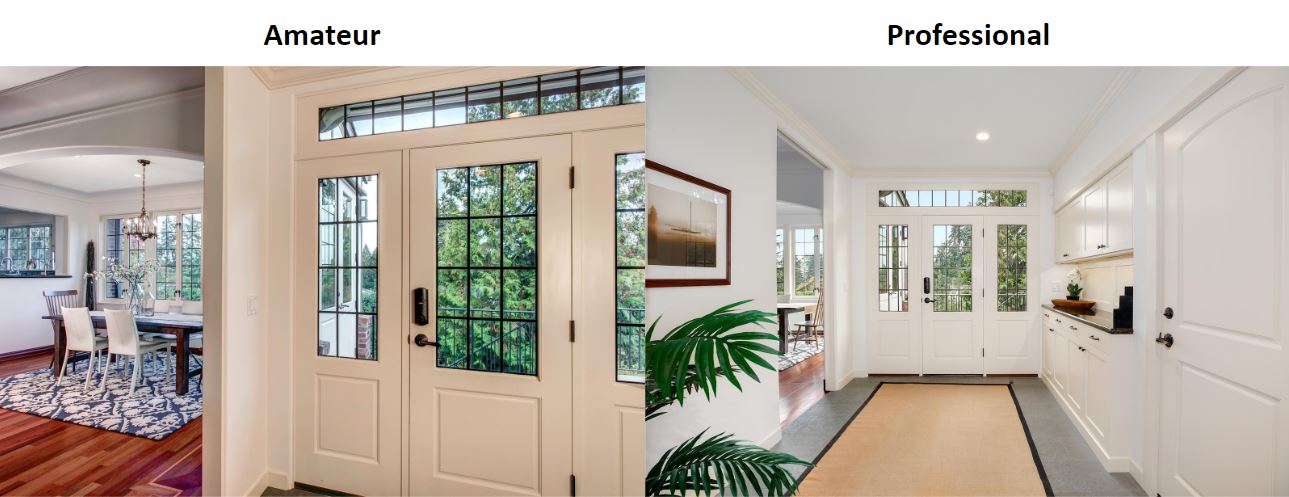
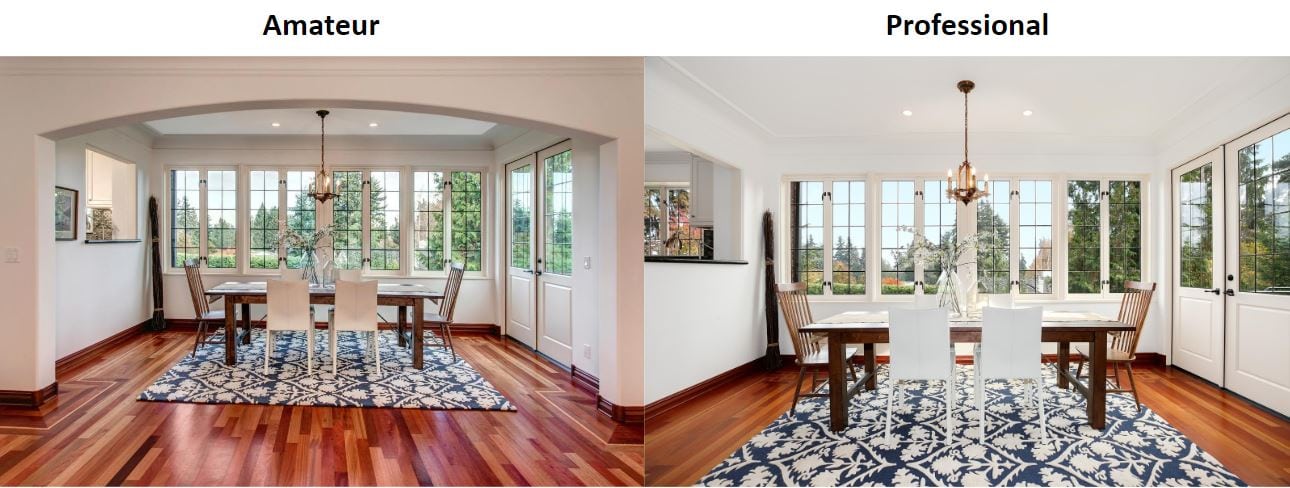
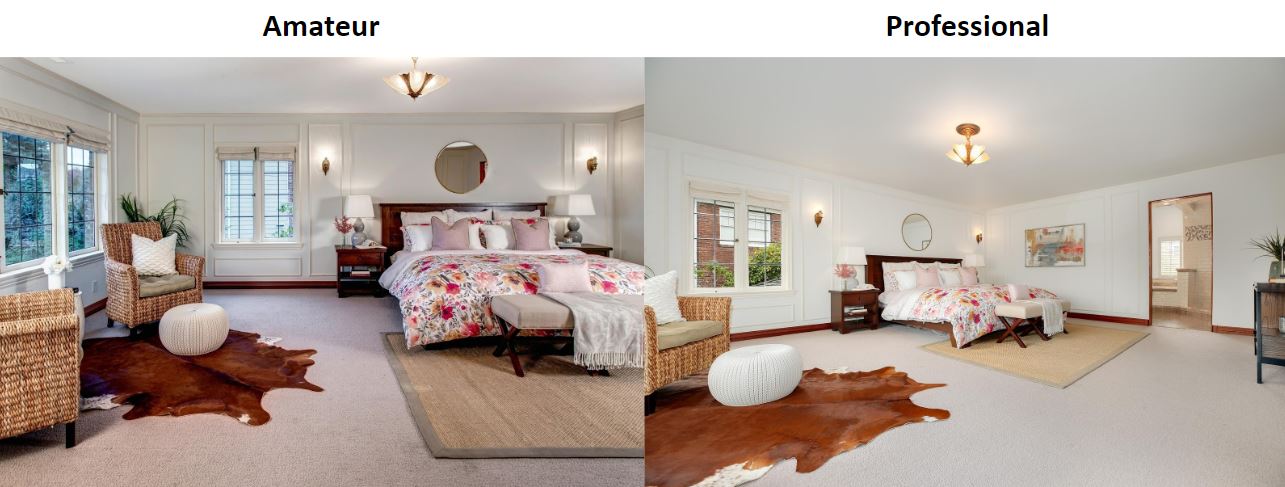
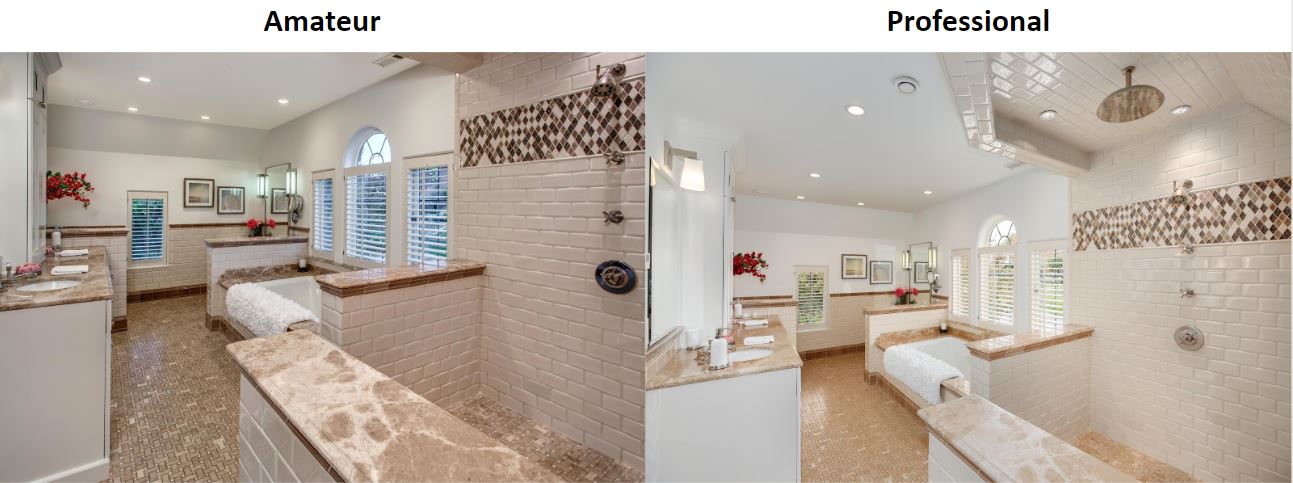
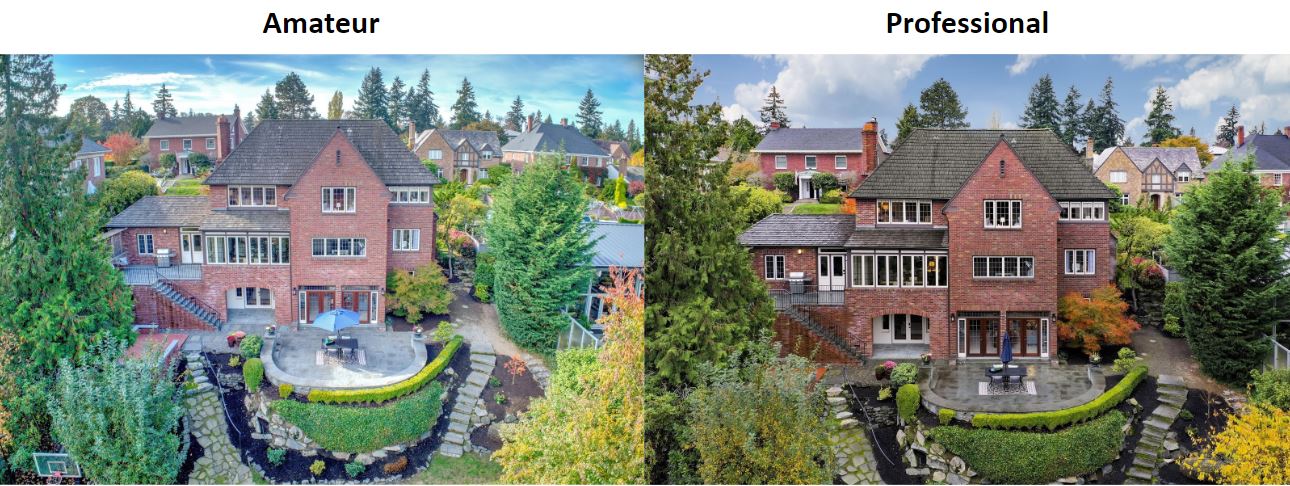
To see these differences in action, Drew shared listing photos comparing those shot by an amateur, and those professionally photographed. “These examples are a chance to really look at the data visually, of the difference between a team approach that builds out quality, versus independent third parties,” he said. “It goes to show how important it is for Redfin to offer quality to the client, and how important it is to make sure our listings are as beautiful as possible.”
“In the above photo to the left, the photographer attempts to connect the front door with the dining area, but in the process, misses all the wonderful entry storage, and the white walls look brown. Redfin’s professional photo on the right chose to instead focus on the expansive hallway, beautiful entry, great storage, and crisp color tones. The professional photographer fully utilizes this space and frames key assets in the hallway.”
“In the professionally shot photo above on the right, the color tones, wood tones, and white balance are perfect. The walls are WHITE. The frame orientation is centered around the chandelier and the photo invites you into this room. In contrast, in the other photo, the room appears to be leaning, the white balance is off, and the colors are dark, almost reddish.”
“Once again, aproper color balance comes into play here. When incorrect, the master bedroom feels small. It also misses an opportunity to show the adjoining bathroom. The composition should highlight the full room to its entirety.”
“This bathroom is bright and light but the white balance is off, and as a result, the images miss key features like the upscale shower head, vanity and lighting.”
“In the first photo, your eye is drawn to other objects, rather than the house itself. The basketball hoop, open umbrella, neighbors to the left and right are distracting and more obvious. Additionally, the home isn’t centered, and the lens distortion bends the horizon line. When photographed correctly, you will notice the sky and the framing. This is a shot that is composed, center and square. The color tones are natural and the backyard feels private.”
Redfin Photos by: Matthew Deering
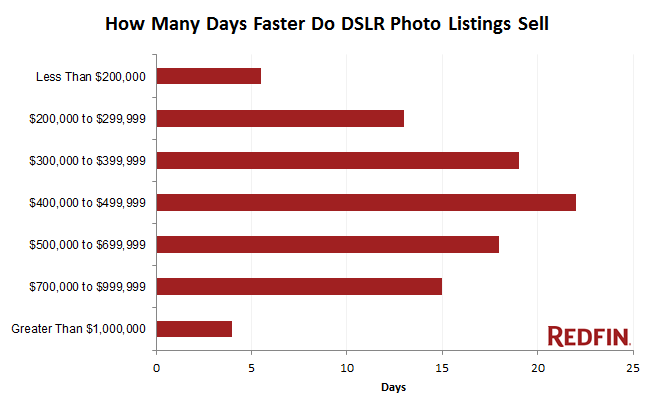
Homes professionally photographed with DSLR cameras are proven to sell quicker and for thousands of dollars more than homes shot with amateur photos.
Inspired by Drew’s insight, we took a look back at the 2013 study. The data revealed that professionally photographed homes priced in the $400,000 range sold three weeks faster and for more than $10,000 relative to their list price, than their counterparts with amateur photos.
Data 2013 study by Redfin
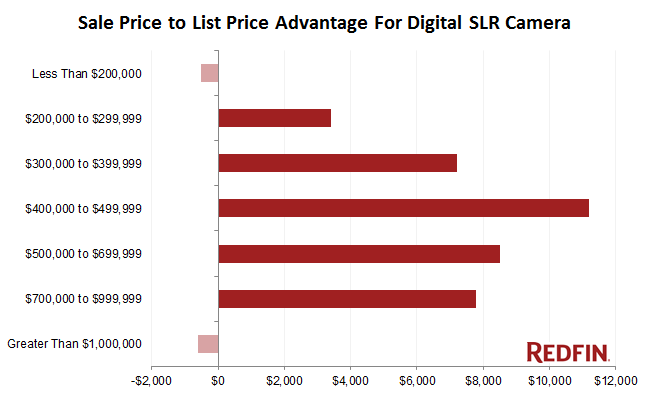
The 2013 findings also found that homes listed between $200,000 and $1 million sold for $3,400 to $11,200 more relative to their list prices when photographed professionally with a DSLR camera. At the high end of the spectrum, professionally photographed homes for more than $1 million sold at prices similar to those with amateur photographs.
Data based on 2013 Redfin study
Additionally, The 2013 findings also looked at photo sharpness, or, the detail added to a picture by using a good camera, lens and lighting. Whether a crisp reflection, or bright flowers, a sharper picture will show a house in its best light. The sharpest 10 percent of photos sold at or above list price 44 percent of the time, while listings with average sharpness sold at or above list just 13 percent of the time.