Nearly one in four millennial buyers say they want to buy a home before deciding to tie the knot, according to a new study from LendingTree.
Young adults are getting married later in life. In 1980, the median age of a first marriage for men was 24.7 and 22 for women; by 2018, those numbers rose to 29.8 for men and 27.8 for women.
But young adults—those between the ages of 22 to 37—say they aren’t waiting on homeownership for marriage, according to LendingTree’s study of more than 2,000 adults ages 22 and older. Millennials comprise the largest share of home buyers at 37 percent, according to the National Association of REALTORS®’ newly released2019 Home Buyers and Sellers Generational Report. Over the next two years, they are expected to enter the housing market in even higher numbers, too.
More young adults believe marriage and parenthood should come after homeownership. Twenty-seven percent of millennial buyers say they are postponing parenthood until after they purchase a home, and 22 percent are waiting to get a pet until they have a home of their own.
For the third week in a row, mortgage rates inched upward, but economists were quick to reassure home buyers and potential refinancers that rates remain still remain well below year-ago averages.
“After dropping dramatically in late March, mortgage rates have modestly increased since then,” says Sam Khater, Freddie Mac’s chief economist. “While this week marks the third consecutive week of rises, purchase activity reached a nine-year high—indicative of a strong spring homebuying season.”
Freddie Mac reports the following national averages with mortgage rates for the week ending April 18:
30-year fixed-rate mortgages: averaged 4.17 percent, with an average 0.5 point, rising from last week’s 4.12 percent. Last year at this time, 30-year rates averaged 4.47 percent.
15-year fixed-rate mortgages: averaged 3.62 percent, with an average 0.5 point, rising from last week’s 3.60 percent average. A year ago, 15-year rates averaged 3.94 percent.
5-year hybrid adjustable-rate mortgages: averaged 3.78 percent, with an average 0.3 point, falling from last week’s 3.80 percent average. A year ago, 5-year ARMs averaged 3.67 percent.
West Coast buyers are in luck: Home buyers in that region tend to stand the best chance of winning the first home they make an offer on, according to a new analysis from Redfin. San Jose, Seattle, and San Diego posted the largest year-over-year increases in the share of home buyers winning the first home they made an offer on.
thelesleyshow – Morguefile
All home buyers may be faring better on that front, though: Fifty-six percent of buyers nationwide who purchased a home in the first quarter closed on the first home they made an offer on, the highest first-offer success rate in three years, Redfin notes. Redfin researchers analyzed the home offer and purchase data for thousands of buyers who purchased homes with a Redfin agent nationwide for the past five years.
“Last year home buyers had to pull out all the stops to land a home in competitive West Coast markets, but this year there are more homes for sale and the odds are more in the buyer’s favor,” says Daryl Fairweather, Redfin’s chief economist. “In San Jose, the market has dramatically slowed from a year ago, and it’s actually now easier to get an offer accepted in San Jose than in many other parts of the country.”
For example, in the San Jose metro area, 63 percent of buyers who purchased a home in the first quarter of this year successfully purchased the first home they made an offer on. A year ago, only 25 percent of San Jose home buyers were successful with their first offers.
In San Diego, more than half—53 percent—of buyers last quarter closed on the home they made their first offer on, up from 38 percent a year earlier.
Homeowners significantly underestimate the costs involved when planning a home improvement project, finds a new study from Discover Home Equity Loans, based on a survey of 1,200 Americans.
Estimated Cost of Common Interior Remodeling Projects
Eighty-two percent of consumers believe the home they own is a financial asset, the study says. As such, they want to tackle home improvement projects to increase the value of their home even more. More than half—52 percent—of consumers say they plan to take on a home improvement project in the next year. Kitchen and bathroom remodels lead in projects. (Read more: Design TV Shows Are Inspiring Optimistic Home Renovators)
But many consumers have failed to save enough. Sixty-four percent of consumers say their home improvement project will cost under $15,000. However, bathroom remodels can cost anywhere from $19,000 upwards to $61,000; significant kitchen remodels can cost upwards to $125,000, according to the study.
Given their low estimates for projects, homeowners are falling short in paying for their projects. Only a quarter say they’ll have enough funds to cover the likely cost of the project, the study showed.
“Home improvement projects can quickly add up and oftentimes cost more than someone anticipates,” says PK Parekh, senior vice president of Discover Home Equity Loans. “Which is why people should be financially prepared and determine which payment method makes the most sense within their own financial situation.”
Homeowners differ on how they’re financing their home improvement projects. Thirty-four percent prefer to use cash for a home improvement project, followed by 23 percent who say they plan to use a credit card. Other owners say they are considering borrowing against the equity in their home, such as through a home equity line of credit (18 percent), home equity loan (13 percent), or cash-out refinance (7 percent).
House renovation and design television programs may be prompting more buyers to shed some of their fixer-upper fears. Nearly 60 percent of home shoppers recently surveyed said that home renovation television has made them more optimistic about renovations, according to a new realtor.com® survey of about 1,000 consumers who are planning to buy a home in the next 12 months.
As inventories remain tight in some markets, home buyers are eyeing properties they once cast aside to look at them under a new lens of how they could renovate it. Nearly 60 percent of the home buyers surveyed say they are considering buying a home that needs renovation, the survey showed.
“Whether it’s seeing the project unfold in a tidy 30-minute segment, or just getting inspired by the before-and-after shots, home shoppers are turning to home renovations to make their dream home when finding one as-is turns out to be difficult,” the survey notes.
Rising home prices and a limited number of entry-level homes are helping springtime home shoppers consider other homes that need renovating, says Danielle Hale, realtor.com®’s chief economist. “Replete with inspiration at their fingertips—like Pinterest, Instagram, and various home renovation TV shows—some home shoppers are comfortable tackling home renovation jobs to find a home that balances their needs with their budget,” she says.
Buyers expect their renovations to make a big difference on the value of the home, too. Ninety-five percent of buyers say they expect some home remodeling will result in a positive return on their investment. Nearly a quarter of buyers surveyed say they expect a positive return of more than 50 percent from their remodels.
They’re willing to spend the big bucks, but is it enough? Slightly more than half of home buyers who are considering a home that needs some TLC say they are willing to spend more than $20,000 on the remodel. Twenty-eight percent are willing to spend up to $10,000, and 22 percent are willing to spend between $10,001 and $20,000. However, a kitchen remodel costs around $66,000, and even a minor kitchen remodel will cost about $22,000, according to realtor.com®. A kitchen upgrade was the top home renovation project that buyers said they would consider. Other popular projects include a bathroom renovation or a hardwood flooring refinish.
Regardless if a buyer wants to DIY or not, it’s important that clients fully understand the benefits and setbacks that can come with taking on a home project, as opposed to hiring professionals to complete the task.
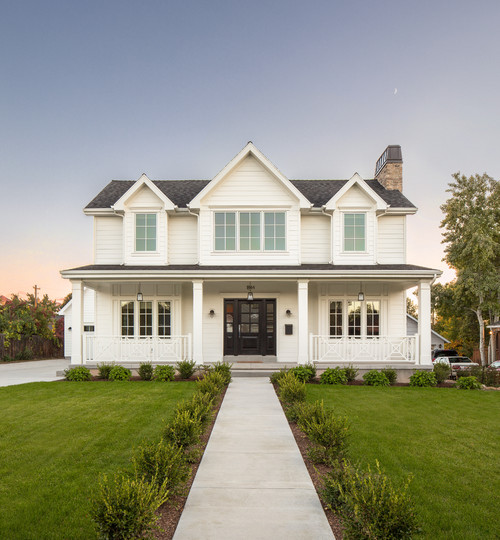
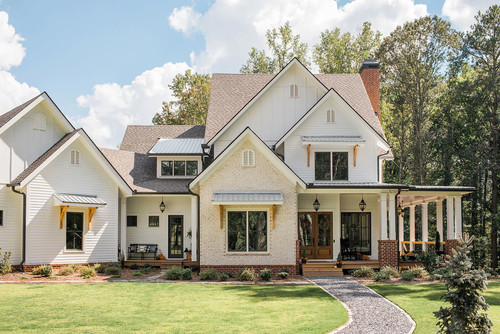
Architectural styles are getting mixed up in home exteriors, but a few trends are emerging. A recent article on Houzz, a home remodeling site, highlights some of the biggest trends in home exteriors, based on the most popular exterior photos uploaded to the site so far this year.
An inviting front porch can offer some nostalgia of sitting outside in a rocking chair or a porch swing, gazing upon the neighborhood. Every one of the most popular front-exterior photos uploaded to Houzz has shown off a front porch, the article notes.
This style blends traditional farmhouse architectural features—such as gabled roof lines, board-and-batten siding, and metal porch roofs—with a modern flair, such as contrasting colors and open floor plans.
Garage doors are gaining more prominence in dressing up exteriors. Opaque glass garage doors are enhancing homes, including modern farmhouse styles. When double garage doors take up most of the front of the home, a glass garage door can lighten the clunky look and offer a shiny touch.
If you’re in the home buying market, knowing what to expect makes everything easier.
Buying a house is a different experience than, well, pretty much anything else. But by knowing what to expect and taking it one step at a time, you can learn how to buy a house like a pro, even if it’s your first time.
Here’s everything you need to know about how to buy a house in 10 steps:
1. Hire a real estate agent.
Finding a good real estate agent is all-benefits, no drawbacks for buyers. It costs you nothing, but will save you so much time—and you’ll have a pro’s know-how throughout the process. Agents have access to the Multiple Listing Service (MLS), which gives them first glance at what’s for sale in the neighborhood you want at the price you can afford.
Trulia can also help connect you with a Premier Agent when you click “Request Info” on any property page. Premier Agents are qualified agents who you can trust to work hard for you. You can also ask friends and family or visit a local real estate office. Prepare a list of questions to ask a real estate agent, and interview them before committing.
2. Shop for a mortgage.
Compare mortgage rates online, and look at the types of mortgages available—conventional, FHA, fixed-rate, adjustable rate—understanding the difference between these will help you figure out how to buy a house that’s right for you.
Get mortgage pre-approval. You may have heard of pre-qualification, which gives you a general idea of how much you might be able to borrow. Pre-approval is the next step—a commitment from a lender for the amount that you can borrow. Pre-approval makes you a stronger home buying candidate—one who’s ready to close a deal quickly, which sellers love.
3. Make a list of needs and wants.
Make two lists: one of must-haves and one of nice-to-have items like the Olympic-sized swimming pool you dreamed about as a kid.
On the must-haves include location—near work, in your favorite neighborhood, by good schools, etc.—as well as number of bedrooms and bathrooms, and whatever else you absolutely can’t (or won’t) live without. Your real estate agent can help you decide what items might best fit on which list based on homes in your market.
4. Browse online house listings.
Take out that handy list of needs and wants and start looking around at what’s available. Use Trulia’s filters to quickly find the right listings to explore. For example, if you want your kids to go to a particular school, the school search feature allows you to search for it and find homes within the district for sale.
The goal with online browsing isn’t just to find a potential home, it’s also to make sure what you want, what’s available, and what you can afford all line up. If not, you may need to adjust your wants and needs.
5. Go to house viewings.
Once you start seeing homes you like, call your agent and ask them to start scheduling viewings. And another, and another. Visit as many homes and open houses as you can. You can use the Trulia app to find open houses scheduled near you. The more comparing and contrasting you can do, the more knowledge you have about the market and your options. Ask your agent for advice about how to buy a house that really fits your needs.
6. Make an offer and negotiate.
Once you’re ready to start home buying, it’s offer time. Here’s where you’ll thank yourself for working with a real estate agent. They’ll help you determine the right offer to make for a particular house, including things that go beyond the dollar amount. For instance, offering an accelerated closing date or to buy and lease back to the buyer if they can’t move right away may be a smart move in some situations. When you make an offer on a house, the seller may accept it or counter-offer, and then your agent will help you decide how and if to negotiate. Once you arrive at a deal everyone likes, you’re considered under contract to buy the house.
7. Get your loan approved.
Remember back when you got pre-approved? Pat yourself on the back. Now you just have to finish things up by making it official. Let your lender know you’ve found a house. The lender will order an appraisal and give you a bunch of paperwork to fill out. Your loan now goes through the underwriting process before it’s finally approved.
8. Wait for the appraisal.
One of the ways your lender makes sure you and your house are a good bet is with a home appraisal. This is when someone does a professional evaluation of how much your home is worth. If the appraisal ends up higher than your offer, go celebrate. If it’s not, you may either have to make a larger down payment, get a second opinion, or renegotiate the price. Or you may decide to walk away from the deal.
9. Hire a home inspector.
Being under contract means you can still back out if you learn anything unexpected about the house. And a home inspector is the one who finds any potential surprises. It’ll cost around $300 to $500 for your home inspection, but it’s well worth saving you from buying a house with a major problem. Your agent can often help you find an inspector, or you can go through the American Society of Home Inspectors.
10. Close on your house.
This is the day you get your house keys—but first, you have some serious paperwork to do. You’ll set an appointment for closing on your house, and you’ll need to bring your driver’s license, a cashier’s check for your down payment and closing costs (which range from 2 to 5 percent of the home’s purchase price) — and a lot of patience. You will sign and initial dozens of papers.
But at the end of this meeting, you will be a homeowner. You can take your keys and go home.
Architectural styles are getting mixed up in home exteriors, but a few trends are emerging. A recent article on Houzz, a home remodeling site, highlights some of the biggest trends in home exteriors, based on the most popular exterior photos uploaded to the site so far this year.
An inviting front porch can offer some nostalgia of sitting outside in a rocking chair or a porch swing, gazing upon the neighborhood. Every one of the most popular front-exterior photos uploaded to Houzz has shown off a front porch, the article notes.
This style blends traditional farmhouse architectural features—such as gabled roof lines, board-and-batten siding, and metal porch roofs—with a modern flair, such as contrasting colors and open floor plans.
Garage doors are gaining more prominence in dressing up exteriors. Opaque glass garage doors are enhancing homes, including modern farmhouse styles. When double garage doors take up most of the front of the home, a glass garage door can lighten the clunky look and offer a shiny touch.
DIY home improvement jobs can end in disaster. And even when they don’t, projects can become time-consuming and costly. Botched DIY home improvement jobs can also lead to quarreling among loved ones, shows a new survey from Porch.com, a home improvement website. Porch.com surveyed more than 1,000 homeowners to discover the biggest sources of tension and mistakes during home improvement projects.
jackietrains – Morguefile
A third of homeowners say they tackle house projects themselves in order to save money; they also do it because they enjoy it or because the job seemed easy. Millennials spend more on DIY projects than older homeowners, devoting, on average, $405 per job.
But errors are frequent, the report found. Consumers who made errors in their DIY efforts took five-and-a-half hours longer to complete the job. For example, DIYers who erred on floor installation projects said it took them, on average, 27 hours to finish the job, more than twice as long as those who made no mistakes, according to the survey. Flooring errors were typically the most time-consuming of the DIY projects that Porch.com tracked. Flooring like hardwood, laminate, and vinyl are all installed differently, and early errors in the installation can cause major issues down the road, the report notes.
Household projects that involved electrical work also proved difficult to fix if errors were made. For example, consumers who made errors wiring or installing a ceiling fan needed more than twice as much time to complete the job than those who did it with no problems. Furthermore, basic errors when handling electrical or wiring work can lead to electrical fires and other dangers, the report warns.
DIY mistakes can be costly as well. Consumers who made mistakes on installing floors ended up costing themselves $829 more. “Hardwood can cost homeowners thousands, and poorly laid boards may need to be replaced,” the report notes. “Conversely, tiles can be laid out before any grout goes down, preventing the need to rip them out later. Accordingly, individuals who made mistakes when installing tile paid just $58 more on average.”
Tackling DIY jobs can be stressful on marriages. Fights can be common, according to the survey. Of DIYers who made a mistake, 46 percent ended up squabbling with their significant other over the project. Electrical wiring projects appeared to be the biggest source of conflict. Spats over replacing electrical outlets or installing ceiling fans were frequently reported, according to the survey. “Perhaps the prospect of getting shocked increases the tension in these instances,” the report notes. “One partner might wish to plunge ahead, while the other urges them to stop in the name of safety.”
The recent plunge in mortgage rates may help the market for home loans surge to a 14-year high, according to recent housing forecasts. In the past month, mortgage rates have posted their biggest drop in a decade, with the 30-year fixed-rate mortgage averaging 4.08 percent last week, according to Freddie Mac’s weekly mortgage market survey.
The rate decline has enticed more home buyers to enter the market, prompting mortgage demand to reach its highest level since the fall of 2016. Mortgage applications jumped 18.6 percent last week as borrowers rushed to lock in lower financing costs. Mark Watson, director of forecasting for mortgage advisory firm iEmergent, predicts $1.2 trillion in home lending this year, which would be the best year since 2005. “We think the lower mortgage rates will create a huge push, partly from millennial buyers,” Watson told HousingWire. “That is going to support strong growth in home sales over the next several years.”
iEmergent projects a 3.9 percent increase in total home loan volume this year. That’s more optimistic than other forecasters, such as Freddie Mac, which is predicting a 1.5 percent increase in total mortgage lending for 2019, and the Mortgage Bankers Association, which predicts a 1 percent gain.
But the threat of higher mortgage rates is diminishing. The Federal Reserve announced at its January meeting that due to a slowing economy, it does not plan to raise its short-term key interest rates again this year. Therefore, mortgage rates will likely stay low for a while, which will bode well for the housing market, Watson says. “The benefits of the decline in mortgage rates that we’ve seen this year will continue to unfold over the next few months due to the lag from changes in mortgage rates to market sentiment and ultimately home sales,” says Sam Khater, Freddie Mac’s chief economist.